

Book review - Compelling and informative
Published: Sunday | April 26, 2009
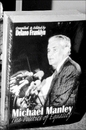
Book: Michael Manley: The Politics of Equality
Reviewed by: Howard Campbell
Michael Manley is, arguably, independent Jamaica's most polarising figure. His liberal policies, driven by a doctrine of democratic socialism, endeared him to post-colonial youth in the 1970s but alienated the country's middle class.
Many of Manley's programmes had a direct bearing on a Kingston College student named Delano Franklyn. A former junior minister in prime minister P.J. Patterson's administration, Franklyn recently launched Michael Manley: The Politics of Equality, a tome revisiting the budget presentations of Jamaica's fourth and most controversial prime minister.
The Politics of Equality is a compelling read and should appeal mainly to scholars and admirers of Manley, the social engineer and thinker. The speeches cover his debut as Opposition leader on June 4, 1969, to his final presentation as prime minister in May 1991. The speeches from 1969 to 1972 set the tone for Manley's first term as prime minister (1972 to 1976). Manley, the social progressive, addresses unemployment and illiteracy among the working class, prejudice against Jamaican blacks, equality for women and promoting self-reliance through initiatives like the National Youth Service.
Unrepentant
For much of his first two terms (1972 to 1980), Manley is unrepentant about his government's support for oppressed African countries like Lesotho, Rhodesia and South Africa, as well as its ties with Communist Cuba. Of interest is the aggression of Manley's delivery in the latter stages of his first terms (1975-80) when domestic and international opposition to democratic socia-lism grows. He confronts the critics head-on in his May 1975 presentation.
"Our aim is a just society. The heart of socialism is the mobilisation. The heart of socialism is the bringing of people into ownership and control of the means of production and distribution," he said.
Manley swaps ideology for reason during his second tenure as prime minister from 1989 to 1992. In his return speech of June 1989, he defends most of his policies of the 1970s while conceding that errors were made. It shows the transformation of a man largely regarded as Jamaica's greatest agent of change.
That, alone, makes The Politics of Equality a winner.