AP
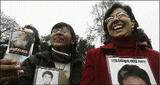
Relatives of people killed at La Cantuta university, during the government of former President Alberto Fujimori, holds photos of family members as they celebrate Fujimori's extradition in Lima, yesterday. Chile's Supreme Court yesterday ruled that Fujimori must be extradited to face human rights and corruption charges in Peru.
SANTIAGO, (Reuters):
Former Peruvian president Alberto Fujimori lost his fight yesterday to avoid extradition from Chile and was to be taken to Lima to face charges of human rights abuse and corruption dating from his 1990-2000 rule.
In a surprise decision that contradicted an earlier ruling by one of its own judges and which cannot be appealed, Chile's Supreme Court said it accepted most of the arguments made by Peruvian prosecutors who want to put Fujimori on trial.
The court was unanimous in accepting evidence from two notorious massacres — known as Barrio and La Cantuta — in the early 1990s, when Peru was at war with the feared Maoist rebel group the Shining Path.
Students, a professor and a child were among the two dozen killed in the massacres, which Peruvian state prosecutors blame on death squads run by Fujimori's government.
"(The vote) was much easier than we thought, and the important thing above all was Barrio and La Cantuta," said Alberto Chaigneau, one of five judges who heard the case.
"The voting was unanimous," he told Chilean, Peruvian and Japanese reporters outside the court. Fujimori, 69, remained under arrest in a rented house just outside Santiago.
There was a heavy police presence in the area and a police helicopter hovered overhead it was unclear when Chilean authorities would deport him.
In his first interview since the court decision, Fujimori acknowledged to Peru's RPP radio that he had made "huge" mistakes while in government but that if he were put on trial he would prove that he acted properly.