
Attempted hijack, squatting, Shaw's budget - Everything is connected
Published: Sunday | April 26, 2009
File
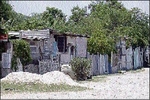
A squatter settlement along Rodney Arms, in Portmore, St Catherine.
Don Robotham, Contributor
WE MUST all be thankful that the hijack crisis ended peacefully and without casualties. The Government and the security forces are greatly to be commended. It could easily have gone awfully wrong - with consequences too horrible to contemplate.
Yet, key questions remain unanswered - not least of all in the security area. At the same time, the apparent psychological state of the hijacker leads us to reflect on the moral and psychological state of our youth. In general, our youth are in despair - and this clearly applies not only to so-called poor youth but also to uptown youth as well. There is a limit to what money can buy and we have passed that limit in Jamaica a long time ago.
Uptown parents (and grandparents!) move heaven and earth to shelter their children from the economic and social chaos of everyday Jamaican life. We shower them with the latest computer games, all sorts of electronic gadgets - from laptops to Blackberrys - with name-brand clothes of every description and with regular vacation trips abroad. Yet, as elsewhere in the society, none of this has proven able to fill the inner void in the lives of uptown youth, which remains dangerously empty.
In such a moral climate, it does not take much to mentally destabilise a perfectly normal uptown youth from a perfectly normal uptown family. Well, one can only say, a sad welcome to this club. Poor youths have been facing this situation for decades to a degree unimaginable to those of us who take material security for granted.
In the past, the moral and psychological outlook of our youth was kept wholesome primarily by the 'livity' of Rastafari and roots reggae. That 'lifeway' supplied our youth with a critique of Jamaican (and world) society and gave them some firm moral and personal orientations. In the 1970s, socialist ideology also partially fulfilled a similar role.
Triumph of global materialism and bling
But since the 1980s, with the triumph of global neoliberalism came the triumph of global materialism and bling. The entire moral atmosphere changed dramatically. Pentecostalism and other forms of Protestantism tried to fill the void but have failed to do so. The majority of our youth find the moral prescriptions of born-again Protestantism unrealistic and unattractive and, (I mean no offence) somewhat hypocritical. Our youth (not to mention us adults!) have little desire to 'make a clean break with our past' and to seek 'deliverance'.
Further, unlike Rasta and socialist ideology, by and large most versions of Pentecostalism with their unremitting focus on purely personal responsibility, lack a critique of structural societal injustice which most Jamaican youth (and youth worldwide) feel very strongly lies at the root of their condition. So the moral and psychological void continues, indeed intensifies.
When a crisis which has been festering for generations at the base of a society begins to explode at the top, watch out - it suggests that the cap of the volcano is breaking.
We must realise the depth and urgency of the crisis facing our society and the youth in particular. This is as much a moral as a material crisis. For years, people have been clamouring for a serious youth policy without much impact. The hijack event is suggesting that time may have run out on us - which leads us to the Budget Debate so far.
The Rosy Budget
Mr Shaw's presentation on Thursday continues to be far too rosy. He stated that this Budget is based on the assumption that the world economy will recover no later than the second quarter of 2010. This assumption will prove to be false.
But the flaw in his thinking is deeper. The assumption is that when the global economy recovers, existing patterns of global economic demand and consumption will simply resume where they left off, pre-crisis. This too will prove to be false. There is good reason to believe that a fundamental restructuring of the global economy is under way and that the profile of global demand in the post-recovery phase will be radically different from what it is today.
This is a government addicted to overly optimistic economic projections. One example: in last year's Budget, the Government's projected increase in revenues from bauxite-alumina was an astonishing 73 per cent! Instead, there has been a collapse of 60 per cent.
Decline in remittances
Remittances, according to the finance minister, are already showing a decline of 16.6 per cent up to February 2009. Tourist expenditure for the same period is down 1.1 per cent. All of this is before the full brunt of the crisis hit. American car sales - a major source of aluminum demand - continue to plummet - the latest development being the impending nine-week summer 'recess' of General Motors. The Jamaican economy is projected (by Mr Shaw) to contract between 2.5 per cent and 3.5 per cent this year. The contraction is likely to be much worse and any recovery, when it comes, will be anaemic.
What is more, what a tax package based on expanded GCT net means is that the burden is going to be spread as far and wide as the consumption of cock and chicken-noodle soup.
This raises a fundamental issue of equity and public policy. Should the aim of tax policy be to spread the tax net as widely as possible - that is to catch all the small fish in the informal sector? Or should the policy be to intensify the burden on the formal sectors and the bigger fish? How should the net be widened and on whom - outward, or upward, or both?
Will the Jamaican people perceive this tax package as fair and just? What will happen when, come next year, the projections turn out again to have been too rosy and even more burdensome economic decisions face us? How will the people react then? It may not be a matter of a failed hijack attempt by a mentally disturbed uptown youth then.
We need a better tax system, less borrowing and a much more efficient public sector. None of this is likely to resolve our underlying economic problems. Our problems are deeper than this analysis recognises. Our deficits are real ones - in the real economy - not just accounting or managerial ones.
The basic fact about our economic life is that the real sectors - bauxite-alumina, tourism, remittances - generate insufficient income to support our consumption. Our second big problem is that what happens to our bauxite, tourism and remittance income is determined by global economic forces not controlled by us.
Our third big problem is that a basic strategic transformation of the global economy may be emerging which could fundamentally alter the pattern of global expenditure in these three crucial areas for good. I shudder to think what a Jamaican economy - sans bauxite, sans tourism, sans remittances - would look like!
Squatter settlements
Solutions to this gloomy strategic economic outlook are really what our budget debate ought to be about. For everything is connected: our social, moral, psychological and economic crises are parts of the same puzzle. The massive increase in squatter settlements is a case in point. The reason why the number of squatter settlements has proliferated is because, on the one hand, with the decline of sugar and bananas, our rural economy has collapsed. And, on the other hand, Asia and elsewhere have made us uncompetitive in manufacturing so there is no positive growth in employment and residential opportunities in our cities. The transformations in the global economy are likely to make this worse not better.
So what are people supposed to do? They have to live somewhere and somehow, even if it is only in a shack on illegally occupied land. We should find some orderly way to just give people full legal tenure in these settlements and provide them with as much decent infrastructure and other social services as we can. Which sectors of Jamaican society is to bear the costs of this? It can only be the already overburdened formal sectors and the already stressed-out uptown society from which Stephen Fray originated.