
CaPRI weighs value of stimulus plan
Published: Wednesday | March 25, 2009
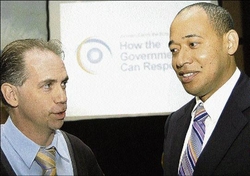
Dr John Rapley (left), president of Caribbean Policy Research Institute, chats with Richard Chen, vice-president of the Private Sector Organisation of Jamaica (PSOJ), at the PSOJ Chairman's Club forum at The Jamaica Pegasus hotel in New Kingston yesterday. - Rudolph Brown/Chief Photographer
CaPRI, the Mona-based independent policy research think tank, having studied the flow of funds under six programmes in Bruce Golding's stimulus package, is now analysing whether the monies would have been better spent on social projects and security jobs.
The six programmes represent $4.6 billion, or 0.59 per cent of GDP, of a package announced in December.
Wednesday Business estimated the value of the Golding rescue plan at $28 billion.
Executive director of CaPRI, Kim-marie Spence, said yesterday that as data becomes available, other programmes under the stimulus plan would be included in the analysis.
It was not clear from CaPRI's (Caribbean Public Policy Institute) initial findings what impact Golding's stimulus package will have on broad performance in an economy which the Planning Institute of Jamaica (PIOJ) projects to decline by 2.9 per cent this fiscal year.
However, the think tank says that had the Government spent the $4.6 billion - so far accounted for in an ongoing study - on say social infrastructure or security, it might have hired 4,000 new police officers or educate 279,000 children at the early-childhood level.
Skills training
If the spending were at the level of HEART Trust/NTA, the government agency that provides skills training to people who leave school without certification, then the training 62,082 youngsters could have been financed.
It would seem, though, based on survey CaPRI researchers did among businesses, that Mr Golding's stimulus package may have greater efficacy in boosting the bottom lines of firms than creating jobs.
Nor does it appear that recent sharp rises in interest rates, about which business leaders have complained, have immediately undermined firms.
John Rapley, CaPRI's chairman, told reporters that only 16 per cent of businesses surveyed said that they would be undone by interest rates in the near future. "In the short term, majority of businesses surveyed say they can manage with the current interest rate," Rapley said.
Moreover, 78 per cent reported that Golding's initiatives helped to improve their bottom lines. Only 15 per cent said they had lowered their need for firms to lay off workers. "The package then would have served to more boost profitability and, to a lesser extent employment retention," Rapley said.
The data, however, is still being refined.
Golding announced his stimulus package in the face of the meltdown on world financial markets that sent the global economy in a recession that has already begun to hit Jamaica hard.
The initiative covered 15 specific undertakings, including tax concessions to individuals and firms, increased loans to businesses, including to small and micro enterprises and spending on infrastructure work.
Wednesday Business estimated the cost of Golding's package to have been $28 billion, but in the absence of clarity about specific programmes that figure might include some level of double counting.
In CaPRI's case, the institute has, up to this point, limited its assessment of the impact over a one-year period, on the fiscal accounts for six specific undertakings:
Increase in tourism advertising - $265m.
Increase in income tax threshold - $575m.
abolition of tax on dividends - $130m.
Increase, from $1m to $3m, the threshold for payment of GCT - $773m.
Removal of customs user fees from capital goods - $2.507b.
Reduction in the rate of GCT paid by hotel - $303 million.
$4.6 billion per year package
"The six initiatives of the stimulus package, by CaPRI's estimates, cost at least $4.6 billion (over one year), or approximately 0.59 per cent of Jamaica's GDP (gross domestic product)," the institute said.
However, the agency has been hampered by the lack of feedback about elements of Golding's initiative, including the cost, officials said, of delivering loans ($24.1 billion by Wednesday Business estimate) promised by Golding.
"It is therefore to be expected that this figure is likely to be revised further as new information is added," said CaPRI's executive director. "Nonetheless, as a ballpark-estimate, it does appear that the final figure may cohere in a range of less than one per cent of GDP."
The Government had projected the fiscal deficit for the fiscal year closing this month at around 4.5 per cent of GDP, but that is now likely to rise closer to seven per cent.
sabrina.gordon@gleanerjm.com