
FSC ready to welcome investment clubs - But limits membership to 20
Published: Wednesday | March 25, 2009
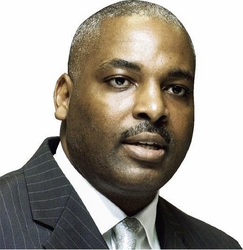
Barnett
Jamaica's Financial Services Commission (FSC) has laid out the broad criteria under which it would likely sanction investment clubs, including limiting membership to no more than 20, rather than the hundreds who paid money into the slew of unregulated schemes that collapsed in recent years with the loss of billions of dollars of investors' money.
FSC Executive Director Rohan Barnett said Monday night that he was looking into ways in which the clubs could be exempt from the Securities Act.
"The FSC is exploring legislative amendments which will allow a specific class of entity to operate under strict guidelines, but which would not impose the full armoury of regulatory requirements that licensed entities are subject to," the FSC's spokesperson, Nadene Newsome, told Wednesday Business yesterday.
Barnett on Monday night laid out some of the criteria that legitimate investment clubs would have to meet if they were to get the nod from regulators, including:
Capping the membership of the clubs to no more than 20 persons.
Requiring that all club members take part in investment decisions.
Requiring that all members invest equal amount of funds.
Prohibiting the payment of administrative fees to one club member.
Placing a limit on the amount of funds that can be invested in any given year.
Hot-button issue
The issue of what precisely are investment clubs and how they should operate is a hot-button issue in Jamaica, particularly over the last three years when regulators began to insist on their right to police a range of investment schemes that claimed to be trading in foreign exchange.
The most prominent of these was David Smith's Olint, which fought a fierce legal battle - which it lost - in the courts against the FSC's demand that it had to register as a operation offering its services to investors.
Olint, which offered its investors returns of 10 per cent per month, argued that as a private club it was outside the regulator's frame.
However, a number of copycat and feeder schemes - which the FSC believes were Ponzis - crumbled, leaving investors out-of-pocket for billions of dollars.
Think tank CaPRI at one time estimated that the schemes were valued as much as $100-$200 billion.
In Olint's case, Smith has been charged in the Turks and Caicos Islands - where he moved his operation to escape the containment to Jamaican regulators - with fraud and money laundering.
Three of the top players in another scheme, Cash Plus, are before the Jamaican court for fraud, including the founder of the company, Carlos Hill.
Appetite for risk
Until Barnett's statement at an investor's forum organised by First Global, the FSC had not defined what it would recommend to legislators to be categorised as investment clubs.
Jamaica's regulatory laws are now silent on the the issue, officials confirmed.
"A proposal has been developed and we will follow the usual legislative process in implementing these proposals," Newsome said.
Meantime, Barnett, in hisMonday night speech, warned of an extraordinary appetite for risk among Jamaicans, which made them susceptible to schemes like Olint and Cash Plus, which offer high returns.
Unlike Olint, Cash Plus never claimed to be in the foreign-exchange market, but an investor in real estate and commercial enterprises. However, when founder Carlos Hill was arrested and charged with fraud, receivers found that his companies were billions in the red.
"There is a large appetite for risk in Jamaica," Barnett said. "I don't know if is driven by greed."
This predilection, the FSC boss suggested, made people, it appeared, willing to accept the arguments and claims on the offers of high-risk investments over the warnings of regulators.
Foreign-exchange trading
A case in point is investors in one foreign-exchange trading scheme, World Wise Partners, which was shut down by the FSC last year, but given time to pay out investors.
Investors have not been paid and, according to Barnett, his agency is being blamed, ostensibly for blocking the payments.
Said Barnett: "The FSC has been receiving a number of calls from participants in World Wise asking, 'Why are you preventing us from receiving our monies?' A cease-and-desist order was issued on World Wise in 2008 with a time period of 90 days given for payouts. They have allowed this to lapse. They have been using delaying tactics and confusion to hold off their members," he charged.
avia.ustanny@gleanerjm.com