
Seaga: Jamaica's financial mix needs changing
Published: Thursday | January 29, 2009
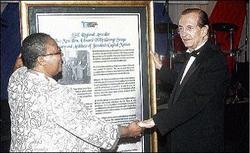
Former Prime Minister, Edward Seaga (right), accepts a citation detailing his visionary work with the Jamaica Stock Exchange (JSE) from Marlene Street-Forrest, the general manager of the JSE, during the organisation's opening Grand Gala Banquet of the Third Regional Conference on Investment and Capital Markets, in Montego Bay, on Tuesday night. - Photo by Adrian Frater
Western Bureau:
While noting that the full impact of the current global recession is yet to hit Jamaica, former Prime Minister Edward Seaga believes that Jamaica's financial reality needs to undergo fundamental changes if the expected economic fallout is to be minimised.
Speaking at Tuesday night's Jamaica Stock Exchange (JSE) Opening Gala Banquet for the Third Regional Conference on Investment and Capital Markets, which is being held in Montego Bay, St James, Seaga - who was honoured as an architect of Jamaica's stock market - said that while other countries are reducing interest rates to stimulate their economy, Jamaica has been doing the opposite.
"Isn't it odd that, while other countries are reducing interest rates, Jamaica is not?" asked Seaga. "Is it not odd that while other countries are seeking economic expansion to grow their way out of the recession, Jamaica is contracting its economy? ... Something is wrong. That policy mix needs urgent review."
Profit margin too small
Commenting on the recent US$300 million Inter-American Development Bank loan secured by the Government, Seaga said commercial banks, through which the funds are to be released to the private sector, might well consider the profit margin too small because they have become accustomed to super profits.
He suggested that, as a solution, a stipulated percentage of such a loan could be used, to replace other deposits in the prudential reserves held by the BOJ (Bank of Jamaica) on behalf of banks, as approved securities.
"These deposits can then be loaned, providing an incentive to the banking system, as was done in the 1960s to encourage agricultural loans," Seaga said.
He also argued that superprofits gained through high-interest debt instruments issued by government, as monetary policy to stem the demand for foreign exchange as well as stabilise the exchange rate, was having a negative impact.
"The exchange rate has created an unhealthy 'Las Vegas' investment culture in Jamaica that no longer accepts moderate investment returns as sufficient," stated Seaga. "This led to Cash Plus and Olint being very attractive investment models."
Great impediment
He added: "It reinforced a banking system now structured on superspreads with superprofits. Nowhere else in the English-speaking Caribbean does the banking system enjoy prohibitive lending rates as in Jamaica. ... These high rates are a great impediment to investment and, by extension, economic growth, because few investments can tolerate mega-rates."
Despite the fact that tourism, mining and remittances are arguably facing the greatest threat from the global economic meltdown, because of Jamaica's limited scope to generate earnings in other areas, Seaga said he believed these three sectors would remain critical in determining how much stands up in this financial situation.
"In the absence of new and additional export earnings, the future of the economy will rest on growth in tourism, mining and remittances, precisely the three areas of vulnerability now under pressure because of the global crisis," Seaga said. "It will come back, therefore, to how the economy weathers this global disaster."
Creative solutions to economic crisis
The three-day conference, which is being held under the theme, 'Competition or Collaboration', is geared towards finding creative solutions for the Caribbean region to minimise the impact of the economic situation, which has been creating global anxiety and fear.
Following his presentation, Seaga was presented with a framed citation detailing his "visionary" work with the JSE. The citation in part stated that he "used his sphere of influence to establish, encourage and promote the development and modernisation of the financial sector".
adrian.frater@gleanerjm.com