Nashauna Drummond, Lifestyle Co-ordinator
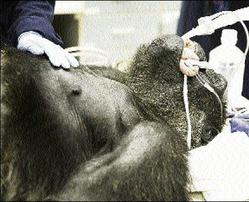
A sedated Donna, prepped and ready for surgery. - Contributed
In his 26 years of practising obstetrics and gynaecology, Dr Gerald Mulvaney has seen many things. But, never did he think that he would some day operate on a hairy, four-legged, 400-pound patient with an appetite for bamboo. In walked Donna the gorilla, and this Jamaican-born doctor who practises in North Carolina, was given the chance to do something not many medical doctors have done before.
Donna is a 38-year-old, female western-lowland gorilla that lives at the North Carolina Zoo in Asheboro, which is about an hour and 15 minutes from Dr Mulvaney's practice at the North Carolina Centre for Reproductive Medicine (NCCRM) in Cary.
Hysterectomy on a gorilla
Over breakfast at the Courtleigh hotel in New Kingston, Dr Mulvaney explained that Donna had cancer of the uterus and was haemorrhaging. She was under the care of senior veterinarian Dr Ryan De Voe, of the North Carolina Zoological Park. Dr Voe contacted Dr Sameh Toma and Dr Mulvaney, to assist his staff in doing a total hysterectomy on Donna on August 27.
This was a follow-up procedure to surgery they performed in November 2007, which resulted in a diagnosis of endometrial cancer. "The first two procedures that we performed were hysteroscopies. This is a procedure that is done through the vagina. It involves using a small telescope type of instrument that allows us to look inside the uterus," explained Dr Mulvaney. "We were able to remove tissue from the inside of the uterus and this allowed us to confirm the cancer. We had hoped that this less-invasive procedure, combined with medication, would help cure her or at least slow the growth of the cancer. Prior to our involvement in this case, the veterinarians had attempted a hysterectomy but ran into problems because of the extensive adhesions in her abdomen. They abandoned the case and sought our help at this point because we have more experience with these types of cases, and the anatomy is very similar. Donna had a total of four surgeries and has survived them all."
Giving back
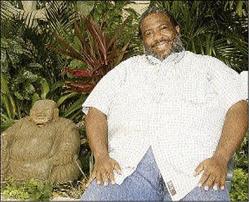
Dr Gerald Mulvaney mimics a statue of Buddha at the Courthleigh hotel in New Kingston during his recent visit to the island. - Colin Hamilton/Freelance Photographer
He continued: "The surgery part is not a big deal. Once you go in, you do what you are trained to do," the jovial Dr Mulvaney said. Not wanting to take all the credit, he was quick to emphasise that the veterinarians did a lot. "She was tranquillised, the vets incubated her. Then she was shaved, they did everything," he said.
Though many may see this as a fascinating feat, Dr Mulvaney sees it as his way of giving back.
"The big picture is giving back for all the years we've operated on animals to benefit humans. Now we use the expertise from working on humans to give back to animals that have suffered so long. It's the reward for me, doing things I've never done before."
Dr Mulvaney left Jamaica at age 14 when his family migrated. He was then a third-form student at St George's College. He attended Brooklyn High School, then a six-year medical programme at Boston University. His residency was done at Kings County Hospital. He also came back home and did stints at Bustamante Hospital for Children and a few months in the hospital at Black River, St Elizabeth. His initial plan was to do paediatrics, but while doing his surgery rotation he fell in love with it.
"I like the casualness of surgery because I'm in my scrubs all day and then I was good at it and enjoyed the environment," he explained. He continued: "I didn't want to do general surgery, women are so complicated and I was fascinated by them. This provides a continuity with the children, plus I get to play with the babies first. I love nights and babies are mostly born at nights. If you find something you're good at, it's not a job."
He notes that his family life in Jamaica may have planted the seed for his pursuit of medicine.
"My grandfather was a dispenser. I used to play with his microscope and read his books. When I was nine, my maternal grandmother died. At three in the morning she woke up with chest pains and they said it was gas pains. No one knew what she had. The all-knowing adults did not know. In retrospect, that's the seed for my medical training."
Stay out of trouble
Dr Mulvaney notes that his childhood in Jamaica allowed him to achieve all that he has.
"The lessons I learnt in Allman Town are what have carried me through. They have allowed me to stay out of trouble." With a passion for photography and racecars as well as being the lead vocalist in a reggae band, Dr Mulvaney notes: "I have never lost my identity and that is what has made me successful. Unless Jamaica sinks under the Caribbean Sea, I can go back. I always have a home."
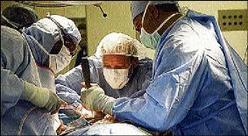
Dr Mulvaney (left) and other doctors at work. - Contributed photos
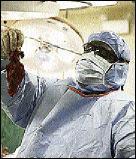
Jamaican-born Dr Gerald Mulvaney with Donna's uterus after a complete hysterectomy last month.
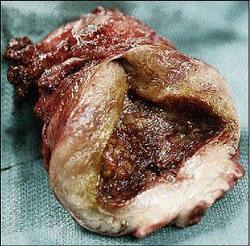
Donna's uterus that was removed during her hysterectomy, showing the cancerous cells inside.
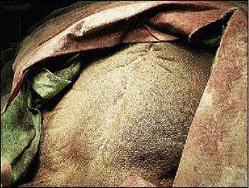
Donna is almost back to normal recovering well after her surgery.