
Kenneth Gardner
The benefits we get from exercising are specific to the type of exercises. The development of strength, endurance and flexibility are very specific goals and require specific exercises.
Strength itself may be divided into three discrete subfactors. It can be dynamic, static or explosive. Dynamic strength displays the ability to move or support the weight of your body repeatedly over a given period of time. Static strength displays the ability to exert maximum force continuously for a brief period of time. Explosive strength displays the ability to exert maximum energy in one short burst of effort.
Endurance is assessed on the basis of our ability to pursue strenuous tasks that involve large muscle groups for an extended period of time. Flexibility is assessed in relation to the functional capacity of our joints to move through a full range of movement.
Specificity principle
To get the best results from our exercises, we should be guided by the specificity principle. Our goals for exercising should be well established such as weight loss, increased muscle mass, improved muscle tone, improved strength and so on. An exercise programme should then be designed to elicit the greatest gains possible. The exercise programme must overload the body parts, muscles or systems in ways that are similar to how we want them to work for us on a regular basis. If you want to improve the strength of your upper body, the exercises should target the muscles in the upper body rather than a general exercise programme emphasising muscle strength in a variety of muscle groups.
If your aim is not limited to specific fitness goals, you can engage in a variety of exercises. A comprehensive exercise programme involves exercising the whole body for its use in a variety of ways. An exercise programme that incorporates both arms and legs does more for the body than one that involves just the arms or the legs.
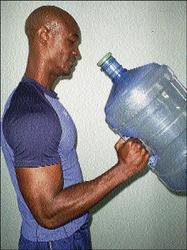
Don't have dumb-bells? Use what ever is handy around the home to work the biceps and triceps. - photo by Daviot Kelly
The following exercises address different areas of fitness:
Aerobic exercise - wood chopper
1. Stand with your feet together and hands by your sides.
2. Jump and place your feet out to the sides, while swinging your arms up to the sides and over your head.
3. Keep your legs straight and reach down with your trunk and arms. Try to reach behind your feet with your hands.
4. Bend your legs slightly as you straighten your back.
5. Return to the starting position.
6. Jump and put your feet back together as you swing your arms back to your sides.
Flexibility exercise - spinal twist
1. Start by sitting with your left leg straight out in front, your right leg bent, right foot crossed over the left knee.
2. Stretch and place your left elbow on the outside of your right knee, push the right knee inward.
3. At the same time place your right hand on the floor behind you and turn to look over your right shoulder.
4. Keep pushing with your left elbow and turn with your head over your right shoulder until you feel a good tension along your spine and your hip.
5. Hold for 15 to 30 seconds then repeat on the other side.
Strength exercise - standing barbell curls
1.Start with a moderately heavy barbell on the floor in front of you.
2. Feet parallel to each other, slightly less than shoulder-width apart.
3. Bend your knees over the bar and take a shoulder-width under grip on the bar.
4. Straighten your legs, arms extended at your sides with the bar resting across your thigh.
5. Keep your arms close to your side, keep your back straight as you curl the weight up to your chest.
6. Reverse the movement by lowering the weight until your arms are fully extended.
Dr Kenneth Gardner is an exercise physiologist at Holiday Hills Research Center; email: yourhealth@gleanerjm.com.


















