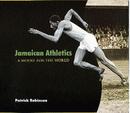
Title: Jamaican Athletics - A Model For The World
Author: Patrick Robinson
Reviewer:Elton Tucker
The story of Jamaica's prowess in track and field arenas all over the world has been told over and over again.Not so well known though, is the background to this success. Why has Jamaica been able to produce exciting and world-beating talent year after year in athletics? What is the secret to the island's success, predominantly in sprint events, at the Olympic Games, International Association of Athletics Federations (IAAF) World Championships, Commonwealth Games, Pan American Games, Central American and Caribbean Games, World Junior Champion-ships, World Youth Championships and the Carifta Games?
Model for the world
In his book Jamaica Athletics - a Model for the World, first published in March 2007, Patrick Robinson answers these questions and more, in simple, but convincing style.
Robinson's background, not as a judge at the International Criminal Tribunal for the former Yugoslavia, but as a former athlete at Jamaica College and one who was a member of their winning Boys' Championships team in 1959, makes him especially competent to write on the subject.
Not by accident
In his introduction, Robinson quotes none other than the current president of the International Olympic Committee (IOC), Jacques Rogge, who noted that Jamaica's achievements at the Olympics do not occur by accident, but a result of "a good system to prepare athletes".
With this as his theme, the author takes us back to the "foundations of the system" and the inaugural Boys' Championships in 1910. He identifies the first real track star produced at the high-school level, Norman Manley of Jamaica College, whom he described as an athlete of the highest quality. Manley clocked a record 10 seconds for 100 yards at 'Champs' in 1911 when the world best was 9.7.
It is Robinson's conclusion that Manley established "a standard of athletic excellence" in schools that was duplicated in years to come by the likes of his own son, Douglas Manley, Arthur Wint, Leroy 'CoCo' Brown and Herb McKenley.
It was this standard of excellence, Robinson contends, which not only laid the groundwork for success at the school level in the 1930s and 1940s, but led to Jamaica's gold-medal-winning performances at the Olympics of 1948 and 1952.
The book, which is brightened throughout by photographs, most in beautiful colour, gives a virtual who's who of the outstanding Jamaican athletes, male and female, of the past 60 years.
It chronicles the achievements of Olympic pioneers, Wint, McKenley, Leslie Laing, George Rhoden and those who came immediately after them in the 1950s, like Keith Gardner, George Kerr and the Spence twins, Mel and Mal. Then it is on to the 1960s and others like sprinter Dennis Johnson, Una Morris, an Olympic 200m finalist (placing fourth) at age 17 in Tokyo, and Lennox Miller and his silver medal at the 1968 Mexico City Games. Miller was still active in the 1970s, along with others like Marilyn Neufville, who set a world record in the 400m at age 17. But the decade belonged to Donald Quarrie, who won gold (200m) and silver (100m) at the 1976 Montreal Games.
Olympic records
Quarrie was still there in the 1980s with a sprint relay silver at Los Angeles in 1984, but the decade saw first the emergence of Bertland Cameron, gold in the 400m at the inaugural World Championships in Helsinki, then Merlene Ottey, who went on to attend a record six Olympic Games for Jamaica winning eight medals.
Women, Robinson notes, went to the Olympics of 1948 and 1952 and he paid tribute to Cynthia Thompson, Vinton Beckett and Kathleen Russell, the "forerunners of Jamaica's dominant female athletes" from the 1980s to the present. Apart from Ottey, those "dominant" females include Seoul 1988 200m silver medallist Grace Jackson, double sprint silver medalist of the 1992 Barcelona Games, Juliet Cuthbert, Deon Hemmings, the first woman from the English-speaking Caribbean to win an Olympic gold medal, Lorraine Fenton, 400m silver at Sydney in 2000, and the current crop, Veronica Campbell, 200m gold medallist in 2004 and her gold-medal- winning sprint relay teammates, Sherone Simpson, Aleen Bailey and Tayna Lawrence.
Nurture local talents
In light of the history of McKenley, Johnson, Rhoden, Ottey, Quarrie, Miller, Cameron, Jackson, Cuthbert and others who honed their talent on the American College circuit, Robinson's analysis of the current effort to nurture the talent locally is particularly interesting.
Under a chapter entitled 'Features of the System - Senior Level', the author attempts to give an explanation of why this is coming so late in the day. He hits the nail on the head when he says the "possibility of scholarships to the United States may also have led to complacency and tardiness in making provision for the training of our athletes at the adult level."
High praises
He has high praise for Dennis Johnson, who, as director of sports at the College of Arts, Science and Technology (now University of Technology), produced several athletes of international calibre who went on to represent the island at Olympic and World Championship levels.
Johnson, as Robinson rightly admits, laid the basis for the current success of organised senior training in Jamaica. No other organisation reflects this more than the MVP Club, under coach Stephen Francis. With Francis directing, the coaching club has been able to develop on local soil, the holder of the world record for 100m, Asafa Powell and Sherone Simpson, the fastest woman in the world over 100m and 200m in 2006.
The pull-outs throughout the text, giving interesting facts on athletes and their performances at numerous championships, make good reading and are particularly helpful for those taking a quick look through the book.
The publication can also serve as good reference material. It details national records at junior and senior levels for both males and females. In this regard, there is just one glaring omission at the high- school level. While the Boys' Champs records are published, there are none for the girls, who have been more successful than the boys at every level since the 1980s.


















