Photos by Michael Robinson
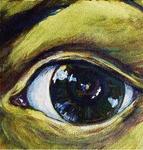
LEFT: 'Eyecon' - Miriam Makeba
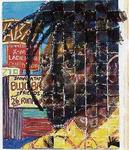
RIGHT: 'Buju'
Michael Robinson, Gleaner Writer
TEXTILE ART and painting merge seamlessly to give life to the inner visions of Deanna Tyson. According to her biography, the freelance artist and tutor has been plying her craft across the United Kingdom for a number of years and is currently the artists' coordinator for Cambridge Open Studios.
While Tyson's biography is unclear about her creative beginnings, it is apparent from the body of work hanging at Harmony Hall that she is a skilled creator with an affinity for Jamaican culture and the African experience. Her chosen subjects range from Buju Banton and Yellowman to Miriam Makeba and Linton Kwesi Johnson.
The pieces are sometimes painted, like her 'Eyecon' series which features extreme close up of the eyes of noted figures like Beenie Man and Ronaldinho in acrylic. Eyes, also known as 'windows to the soul', make for compelling imagery, particularly when the identities of the owners are revealed in the titles.
Viewing simulates the intimate experience of matching stares with some of this decade's most charismatic public figures. One can almost hear their inner thoughts.
Ronaldinho even has a tiny World Cup trophy reflected at the centre of his retina.
Tyson's more interesting pieces combine painting and textiles. 'Purple Haze' depicts guitar virtuoso Jimi Hendrix in a pink and purple fusion of painted features and coloured cloth woven onto a flat surface. A few frayed bits recall Hendrix's trademark afro as two strips dangle at the side like the ends of a headband. Jimi's cool stare looks out from a piece as unique and creative as the rocker himself.
Use of ancient clothing
Deanna's speciality is kimono, the famous robes that have been a part of Japanese fashion and culture since as early as the fifth century. A book on display as part of the exhibit contains more selections of the artist's work. It includes photos of the artist, who was elected Fellow of the Royal Society of Arts in 2006, and various kimonos. Tyson uses this ancient clothing, which nowadays is worn only on formal or ceremonial occasions, as a launch pad for some unique creations.
Employing an array of techniques, including appliqué and embroidery, she uses the silk as canvas, but her messages are the same. Cultural unity and African pride are recurring themes in the work.
Harmony Hall's gallery space is largely dominated by two wall hangings. 'Pirate of the Caribbean' is a woven tapestry hanging from a bamboo rod. Imposed on a black background, a mysterious figure with an enigmatic smile harks back to the early days of the region as home to marauders and explorers alike.
Mounted at the centre of a wall and surrounded by images of Black revolutionaries, 'Freedom Fulani' reads like a quilt. Patches hold the images of Bob Marley, Martin Luther King, Josephine Baker, Louis Armstrong, Miriam Makeba and Muhammed Ali. At the centre are Nelson Mandela and Desmond Tutu. Other names are stitched into the piece, such as Malcolm X, Eartha Kitt and Nina Simone. A fist and the South African freedom call, 'Amandla', sit at the centre of the format.
'Freedom Fulani' is a tribute to important figures in the diaspora who have not only achieved great things within their respective fields, but who represent cultural dignity. The collection of names and faces, viewed together, evoke pride, respect and an appreciation for the cross-cultural nature of the black experience.
Dancehall representation
Contemporary revolutionary, Buju Banton, who helped change the face of dancehall music, is featured in at least three of Tyson's pieces.
Yellowman, Jamaica's first international dancehall star is featured as well. Bob Marley is also represented in two pieces. Musicians from across the globe are also referenced. Music, it seems, has an important role to play in bridging distances between cultures, as do the singers and players of instruments.
In 'Jamaican Toile Kangas', Tyson uses images of contemporary Jamaica along with images of colonial times encircled with the names of the seven national heroes plus those of Bob Marley and Linton Kwesi Johnson.
Marley's achievements as a cultural ambassador and spiritual icon have been recognised internationally, most notably when he was named Time magazine's Man of the Millennium. Johnson, a dub poet and British Black Panther known largely for his anti-Thatcher stance, was awarded the Silver Musgrave Medal in 2005.
The artist is clearly naming her own two candidates for Jamaica's highest national honour.
Deanna's oeuvre is stimulating. Her use of materials and fusion of disciplines creates a body of work that is interesting to look at and fascinating to explore. Add to that her consistent messages and strong thematic influences and the result is a show worth the trip to St Ann.
If creativity begets creativity, then Tyson has made a solid contribution to the cycle that is Jamaican art.