File
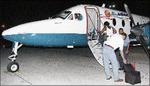
Passengers boarding an Airlink flight in 2005.
Janet Silvera, Senior Gleaner Writer
WESTERN BUREAU:
Stakeholders in the island's aviation industry are attributing its 80 per cent decline over the last 20 years to bureaucratic obstacles from the Jamaica Civil Aviation Authority (JCAA).
"I have watched it die; it is heart-rending to see an industry so significant and so important to every sector of the Jamaican economy go to ruins," bemoans Chris Read, managing director of Airpak Express.
Read, a 37-year aviation veteran and president of the Jamaica Aircraft Owners and Pilots' Association (JAOPA), says the JCAA does not "understand what it is that we do for the economy".
The industry is linked to commerce, tourism, agriculture, search and rescue, medical evacuation and deployment of emergency-response crews to name a few.
But Read charges that government policies are based on the view that aviation is dangerous because drug traffickers avail themselves of the facility.
"And that is one of the main setbacks holding down the industry," Read adds.
Bypass Jamaica
He discloses that several light-aircraft operators have steered away from the island, opting for countries such as Grand Cayman and The Bahamas.
"We are located closest to the largest population of light-aircraft operators in North America, with owners who have a discretionary income eight times the average of the tourists that arrive on the large planes," says Read. "And these people are looking for new places, yet they bypass Jamaica because of the harassment they receive from our authorities when they arrive here."
In response to Read's charges, Colonel Torrance Lewis, director general of the JCAA, advises The Sunday Gleaner that over the last 20 years, Jamaica's general aviation industry has been affected by the introduction of legislation to prevent illegal activity on the various airstrips throughout Jamaica.
Airstrips closed
"A number of airstrips have been closed because of this legislation. The industry came under more effective regulatory control in 1996 when the Civil Aviation Authority replaced the Civil Aviation Department. And security in aviation intensified after 9/11 (terrorist attack)," says Lewis in a statement.
Lewis notes, however, that the aviation industry in Jamaica has grown appreciably, with Air Jamaica moving from nine planes in 1995, to 20 planes in 2005.
Lewis' explanation, notwithstanding, Howard Levy of International Airlink says he has had a Federal Aviation Authority-approved Beechcraft 1900 aircraft sitting on the Tinson Pen tarmac for the last three weeks, awaiting operation-specifica-tions approval from the JCAA.
The plane, which arrived in Jamaica on January 5, and is slated to operate domestic flights between the Sangster International Airport and Tinson Pen Aerodrome, has incurred losses amounting to US$200,000 per month, Levy discloses.
He estimates his company's earnings of US$450,000 per month have been shattered, and his hope of retaining the 50 Jamaicans he employed has dimmed.
International Airlink, through its attorney, Paul Alexander Beswick, has since written to the JCAA, advising them of its plans to take legal action in order to recover damages.
In responding to Levy's allegations, Lewis says currently, the JCAA's flight-safety department is assisting International Airlink to bring its Beech 1900 aircraft on to operation specifications to enable it to operate commercially, but has not given a timeline.
Paperwork
Dudley Beek, a 40-year aviation veteran, is also critical of the JCAA, arguing that the authority treats every operator "like Air Jamaica and everybody must do the same paperwork as Air Jamaica".
Beek has two airplanes that spray bananas, but says he is expected to conform to the same procedures as Air Jamaica. He says he had to submit a manual 22 times before approval was granted for "spray planes that don't carry passengers".
Apart from Air Jamaica, Beek says the country has 15 flyable Jamaican-registered airplanes.
"This is a very small industry with huge bureaucracy on top," he states.
Janet.silvera@gleanerjm.com


















