Mark Dawes, Staff Reporter
Comedian Owen 'Blakka' Ellis interacts with students during Boys' Day at Independence City Primary in April 2006. - Anthony Minott/freelance photographer
The Gleaner Editors' Forum, held last Thursday, dealt with the role of media and violence prevention. As is common in any recent discussion on violence in Jamaica, the matter of how boys are raised came to the fore. Issues related to the need for father-type figures and mentoring relationships with boys necessarily arose.
The event reminded me of a column I wrote in 2002 called 'Juveniles, mentorship and churches' (http://jamaica-gleaner.com/ gleaner/20020908/focus/focus3.html). I argued then that mentorship is indispensable for preparing boys for manhood. I said too that mentoring is not a word that originated in the Church, but it is not an idea foreign to it. Mentoring, I argued, is the same as 'discipling'.
The nation's schools are crying out for responsible men to make themselves available to mentor the nation's boys. Surely, such a strategy can help to curb school violence.
Could it be that the urgency of solving the crime problem has reached the point where employers ought to release responsible men on their staff to do hours of mentoring in the nation's schools? This is the kind of initiative that Government should promote and create tax incentives for those employers that allow their male staff to invest in the training of young men.
Father vacuum
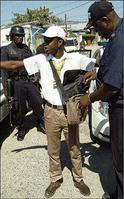
Derrick 'Cowboy' Knight (right), senior superintendent of police, checks this schoolboy's bag during an operation in the Olympic Gardens community, Kingston 11, on Thursday, January 17. - Norman Grindley/Deputy Chief Photographer
Being released for hours to do mentoring is particularly urgent having regard to the father vacuum that exists in the lives of many boys now attending primary and secondary schools. There is something about the way boys are wired that causes them to submit more readily to male nurture and authority as compared to their mothers and female teachers. This is especially so when boys are made to relate to male authority from their tender years.
There is abundant scientific and anecdotal evidence to support the claim that fathers, father-type figures are best poised to influence boys to embrace self-control. In fact, at a tender age, boys think of their fathers as akin to superman. It is a waste of emotional capital for fathers not to make full use of such emotional capital as they steer boys into manhood.
Apostle Paul in writing to a young church leader named Titus gave him a list of instructions for the older women and older men to fulfil. The list is longer for the older women. The older men had essentially one responsibility - teach the young men self-control. The trend, however, has been that it is mostly mothers and older women who are trying to teach boys self-control.
Not for cowards

Rev. Carrington Morgan, executive director of City Life Ministries (centre), walks ahead of his young mentees through the streets of Southside in central Kingston in this 2005 file photo. Rev. Morgan's ministry involves engaging young men 17-25 years old in a programme called I-61. He meets with them once weekly and instructs them in values, basic project management and leadership. - Junior Dowie/Staff Photographer
Back in that 2002 column, I said, "Mentoring is not for cowards. When properly done, it will foster a relationship in which the mentee and the mentor can ask each other just about any question. It requires a great deal of honesty on both sides if it is to work. More important, it is an accountability forum for many. If the truth is told, personal and spiritual growth often comes about in relation to the extent to which one is held accountable. One reason why many Christians fail to get involved in mentorship is because it has a way of disrupting the regular tempo of one's life and it confronts one with the need to be perfectly honest and perfectly transparent - and that can be scary."
Mentoring is a self-sacrificing activity. Effective mentoring will demand a lot of one's time. It requires making oneself available to your mentee even at times when the youngster shows up on your doorstep at an odd or an inconvenient hour of the day. But it is worth it. As the nation continues to grapple with high levels of crime, mentoring is poised to become an activity to be engaged in, if only out of enlightened self-interest.
The spotlight naturally turns to churches as mentoring is what the Lord Jesus Christ has called them to do (St. Matthew 28:19). How much mentoring is happening among members of a congregation? To what extent are there mentoring relationships in churches? To what extent are there formal mentorship programmes in the churches or even informal ones?
Jesus did it
Mentoring is what Jesus did. For the three years of public ministry He assembled 12 men with varying temperaments - Peter, the brash ear-chopper; Judas, a money grabbing treasurer - and he mentored them in the ways of the Lord.
The Bible is not short on examples of the mentoring relationships: Moses and Joshua, Eli and Samuel and Elijah and Elisha.
It is increasingly clear to various family, churches and community organisations that the intentional training of boys for manhood is an imperative ignored at the nation's peril. The mentoring of boys into manhood is an area where the Church ought to lead by example, and thereby become model for the nation as it pursues various programmes of mentorship. Regrettably, in the matter of mentoring boys into manhood, the churches have more to learn than have to teach.
Signposts
Little has, however, been said in the public domain concerning the signposts that boys must pass as transition into manhood.
The Jews have bar mitzvah, African, Asian and Near East societies have clear rites of passage that boys undertake on the road to manhood. Somehow, the Jamaican and Western societies have not embraced the idea of positive rites of passage. What is in place, however, are negative rites of passage that tell boys that to be a man, they must do something harmful to their neighbour, break into a store, maim and or kill people with guns.
There is a book written by Jack Balswick called Men at the Crossroads. An earlier edition of the book carried the subtitle 'I want to be a man, but somebody stole the script'.
It is one thing for responsible men to offer themselves to properly father and mentor boys. But where is the script? Where is the blueprint of what a man is supposed to look like? These are issues for which the Christian community should be bellowing loudly for the rest of the society, but unfortunately it is an issue that it has only recently been seriously thinking through as evidenced by the mushrooming of men's conferences in various church circles.
There needs to be a national conversation about rites of passage to transition boys into manhood. That conversation must take place concurrently in the nation's churches. The research should involve a reflection on church history, anthropological insights, and the biblical revelation.
The way forward must be the creation of clear scripts which fathers and male mentors - indeed the whole society, can use as a reference points to build a new kind of Jamaican man. In other words, the whole country must know what a real man is supposed to look like. A boy in primary school must have in his head a reasonably good idea of what a man should be. It is easier to build boys than to repair men, someone once said.
The creation of such scripts should necessarily involve a wide range of stakeholders in the development of young men.
If churches, communities and the nation in general can establish meaningful mentoring relationships with the nation's young men, and are guided by a good script, I suspect that Jamaica will be well on its way to producing men, not by accident, but by design.
mark.dawes@gleanerjm.com


















