File
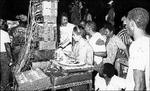
Stone Love in action at Reggae Sunsplash in 1988.
Krista Henry and Melville Cooke, Gleaner Writers
From the outside, the House of Leo on Cargill Avenue, off Half-Way Tree Road, St. Andrew, does not look like somewhere special.
In fact, in the days when it was, for dancehall devotees, somewhere very, very special; from the outside it still looked ordinary, with the same long wall and an unremarkable gateway.
Inside was not a step up the 'special looks' ladder, not with unpaved grounds at first, an older house to the left and a big tree just before an area where there was concrete flooring, where the sound systems actually set up.
But when the music started, especially on a Thursday night, the House of Leo was anything but ordinary.
Into the early 1990s, long before traffic and human snarls were relieved with a one-way system much like that on South Odeon Avenue, House of Leo could have been called the House of Stone Love. And with Rory and his trademark, guttural 'riiiigghht' and sibilant 'so wha!' ruling the selecting roost, it could have been dubbed the house that Rory built.
Too young to remember
Many current dancehall fans are too young to remember the House of Leo, but for those who do, it was a place that popped and sizzled with the essence of the dancehall. Before there was a proliferation of radio stations persons had to go to parties to dancehalls to hear what was going on with the music. In the late '80s into the mid-1990s, House of Leo was that spot to experience the real dancehall culture.
For deejay Beenie Man it was where he got his first break, when his song blared on the Stone Love sound to a crowd of packed dancehall lovers. But he was on a different mission when he had his most memorable moment there.
"One night wi go fi rob House 'a' Leo an inna di middle a di operation dem start play Bad Man, Wicked Man. It was someone anniversary and Stone Love did a play. Fada Pow, Willy Haggart an all a Roses was dere. Wi really go in deh fi deal wid some robbery, but dem play di song an everybody start fire shot. Wi fire two shot inna di air an di light wire shoot off an dat was di end of di dance. Mi go fi rob di place an a dehso mi bus. Dat was funny," Beenie Man said.
House of Leo was where Renaissance Disco really began to make its name in the dancehall. When the sound started out many years ago it was their means of making a mark. Delano from Renaissance says "the House of Leo was the place for the dance when the dance was big. You would see people in the latest clothes as usual and the vibe was always great. You could always get the real Jamaican dancehall from there. At the time they had brought us to give a different flavour; dancehall people knew us after that".
According to Delano, the House of Leo personified the atmosphere of dancehall, bringing the music to locals and foreigners alike.
Learnt a lot from 'Leo'
Booking agent, Jerome Hamilton, of Headline Entertainment, claims to have learnt a lot from his time at the House of Leo. He describes the venue as a benchmark of early dancehall which helped to not only make dancehall prominent, but also immortalised Stone Love. "The House of Leo was the most consistent party venue at the time. Located on Cargill Avenue, for years it was the prime dance venue alongside GoGo, Up Park Camp and La Roose. House of Leo was where Stone Love made its name. Thursday was their night and that was a huge night where middle and upper classes discovered Stone Love," he said.
He continued, "It was also very fashion conscious. It was a mixture of crowd, the traditional hardcore dancehall people, you also had the uptown crowd. That was when dancehall was more people friendly. There was also a strong following of young people. One thing about House of Leo, it covered a wide spectrum of persons. There was also strong following among the entertainers."
That cross-section came from the proximity to the physical and social dividing line of Half-Way Tree. Taxi drivers were not afraid to go there in the nights, so there was always a way to get to and from, even if it meant taking a trek up to the clock after the dance was over.
For those who were into dancehall at that particular period and place, there is a special from Cocoa Tea and Buju Banton in which the Gargamel captures the premier dancehall venue and sound system combination at the time. He chants "whap dem one Stone Love whap dem two/ova Grove Road or Cargill Avenue".
And Stone Love Movements did.
'Stoned' on House of Leo
Mel Cooke, Freelance Writer
For University of the West Indies (UWI) undergraduate students of the early 1990s in tune to dancehall, the House of Leo on Cargill Avenue was the perfect spot.
It was far away from the campus at Mona to make going there seem like actually going somewhere, but not so far that the taxi fare could not be split four or five ways without breaking the bank. It had enough tough-looking characters and doses of gunshots to carry that aura of danger which could keep the tales going (and growing taller) until the next week and there was always the second-hand weed smoke to inhale.
Although the night was Thursday and there was school on Friday, it did not end so late that those who had early classes (and actually went to them) could not get up in time.
Going to a dance
And, to top it off, there was Stone Love, long popular through the cassettes that were rewound and listened to over and over by many long before they went to a Stone Love dance. Ah, that was the difference. For the UWI students of that era there were campus fêtes and parties, but going to House of Leo was going to a dance.
S Silverhawk, which would 'fly down' on Stone Love and any other sound whenever and wherever possible, was the sound system to which I pledged my undying loyalty, off to House of Leo I went regularly somewhere from 1992 to 1993, along with the dancehall-minded from Chancellor Hall, and on one outstanding occasion, Mary Seacole Hall.
Of course, we felt as if we were making a discovery, but we were around for just a short time in a long history.
Two things that stood out about the sound system was the quality (we soon dubbed Stone Love Movements an oversized CD player, this at a time when the shiny discs were yet to get a foothold), as there was this incredibly crisp top end, very present mid-range and a bass that was superbly solid, all balanced to a delightful mix. Then there was Rory ("the short Chiney yute," as we soon dubbed him), with a voice not too far from a radio announcer's but still not too refined for dancehall, along with Cancer on the turntables.
Favourite
There were those who would wait outside the gate with the drinks man and not pay their musical rate and forward through the gate until Rory, a favourite with the ladies, went in.
In addition, as they were mostly playing on their own and the guests, if any, were friends, Stone Love concentrated on 'juggling', mixing records into each other until the dance reached a fever pitch, rather than clashing or presenting individual songs. There were a few sounds you would hear at House of Leo, primarily Gemini and Metromedia. I was there when Rennaissance played at House of Leo for the first time.
And there were sounds you would not hear there with Stone Love. Big sounds that were into clashing. Sounds like Silverhawk with Richie Poo. Bass Odyssey with Squingey. Kilamanjaro with Trooper. Bodyguard. Inner City with Wally.
It was also an era when the various crews were emerging, along with their hot girls and hot dressing, and it was at House of Leo that the Black Roses with Willie Haggart and Bogle really stood out. I had seen them before, outside a Silverhawk dance in August Town, but this was more regular and close up.
Risqué clothes
Not too close, though. You were from uptown, but you knew enough to know that at House of Leo there were some people you did not look at too closely. And there were those it was quite OK to look at; the women who dressed in less clothes than the most risqué girl on campus.
We looked.
It was in that era that Stone Love had its golden run of specials, well past its more funk beginnings; included were Forever Young with Wayne Wonder and Buju, Ice Cream Sound with Johnny Osbourne and Shabba; Soun' Fi Dead with Buju, all on the immortal Real Rock rhythm. Then there was Spragga on the Stagalag with "Stone Love moving up the line" and Nitty Gritty on the same rhythm rejoicing "good morning sound boy long time Stone Love reach ya". Then Capleton dropped Tour on the Corduroy rhythm as a special and the dance turned over.
The mating of happy-go-lucky undergraduates with genuine hardcore dancehall people, who were not visitors to the culture leaping from the oversized speakers, had its strange moments. I can still remember the bemused and scornful looks a group of students who formed a conga line in House of Leo attracted.
There was nothing funny about the violence, though after each round of gunshots (it was not an every-week occurrence it accelerated coming on to the end) we would be back the next week, muttering in a wanna-be dangerous way "suppose me dead yasso an a school me did suppose to a come".
Looking bad, being bad
Among the regular enough gunshot incidents was one where I had to laugh from my strategic position in a corner, as I saw a Stone Love selector with a dubplate in front of his face, peeping around it as he said "de man dem fi stop dem ting yah Iyah".
And we learnt that looking bad was different from being bad, as in one episode a friend was on the ground when a man in a see-through shirt that was one bad man marker of the time, dove full-length into the dirt beside him and turned his tough-looking face to say "me cyaa tek dem ting yah".
OK, so it had its funny moments, like one friend throwing his girlfriend over the wall and following when the gunshots started. We said that she was so skinny she did not get hurt anyway; just floated down like a blade of grass, gravity be damned.
In the end, I think that is the gunshots that killed House of Leo for us. That and graduation. Sure, there were the police raids, but all they did was search. But when you heard what sounded like a bike backfiring, then the sustained popping sound over the music from sound system that meant real gunshots at a place where there was only one entrance/exit, you really thought what the hell you were doing there, Stone Love or no Stone Love, Rory or no Rory, Cancer or no Cancer.
In addition, dancehall was going indoors and retreating downtown under the pressure of police raids. Cactus in Portmore and Mirage at Sovereign became the dancehall hot spots, especially the former.
Eventually the crowds got smaller and smaller, and House of Leo fizzled, just like the Grove Road Centre on the other road leading down from Half-Way Tree Road, just across from Tangerine Place.
There is a lasting legacy, though. Those House of Leo trips led directly to Stone Love playing at the UWI Students Union for the first time at Chancellor Hall's annual 'Spectrum' concert in 1993, an event that simply rammed the Union. That in turn led to more sound systems and dancehall artistes (Shabba had come to Spectrum in 1991, along with Buju Banton who back then just only had Browning and Black Woman) and the cultivation of a whole new degree of modern dancehall fans. (After all, the Union was long a regular Jah Love venue.)
Own sound systems
In some ways there was no more need for UWI students to go to a House of Leo, even if one existed. House of Leo had come to campus, with some blocks on Taylor and Chancellor halls especially having their own sound systems. There was even a clash between Chancellor's Block Che and either Roosters or Butchers on Taylor Hall.
I went to House of Leo three times after I left Chancellor Hall. The last time was the last dance there, by which time I was working with this newspaper as a sub-editor, in about 1996/'97. It was a sad end to a place that had played a pivotal role in dancehall's development and uptown strides.
I remember that Stone Love did not play. It was a Metromedia dance. Not many people came. There was no ceremony or fond farewells, which was not surprising, not for a musical genre that is short on sentiment and memory.
And that night, along with a friend, I walked (yes, walked) to Peppers on Upper Waterloo Road to another session. A dancehall-style session.
Things had changed and they have stayed changed until the change has become normal.


















