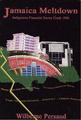
Jamaica Meltdown by Wilberne Persaud
Universe Inc. Publishers 2006
Reviewer: Dr. Alfred Sangster
There has been a great deal of recent discussion on the Meltdown of the Jamaican financial sector in the mid 1990s.
Wilberne Persaud, a columnist for the Financial Gleaner, has expressed his own views and there have been significant inputs from persons like Paul Chen Young, who suffered the total loss of his business in the crash.
The author's book, Jamaica Meltdown, is his take on the crisis.
The author was the former head of the Department of Economics at the University of the West Indies.
He served as a member for all six years of the operational life of the Financial Sector Adjustment Company (Finsac), the organisation established by the Minister of Finance to deal with the bail-out of the local financial sector following the meltdown in the mid-1990s.
Persaud is, therefore, uniquely placed to write about the meltdown of the local financial sector. He was, from that vantage point, able to gain a unique view of the problems and processes.
Jamaica Meltdown provides an analysis of the relevant issues, as well as his own experiences. To begin with, the author makes the point that there are still competing views about the cause or causes of the crash, sometimes conditioned by a person's political leanings.
He argues that dispassionate presentation of the facts coupled with a reasoned interpretation is the best way to settle the arguments.
In economic and policy terms, there are two major views on the financial meltdown: That it was the policies of the Government that precipitated the crash; and the other view articulated by Persaud is that the crash has to be laid at the door of the indigenous financial institutions.
These institutions failed because of erroneous operational methodology, inadequate supervision, errors of judgement, risky adventurism, bad financial practice, or just plain greed.
In addition, he cites some clear cases of fraudulent behaviour.
The issue is sufficiently important in Jamaica's political and financial history to warrant careful review and as such, the review of Persaud's book is being done in two parts.
In addition, the reviewer has taken the time to discuss with some of those who suffered in the crash to get another view. Experts in finance, readers of Persaud's book, and historians will have to judge between these two opinions.
It is the reviewer's opinion and impression in asking around that not many people - certainly among those who suffered in the crash - have taken the trouble to read the book.
There have not been many published analyses of the meltdown issue itself and this is a pity, for the meltdown has had a devastating impact on the Jamaican economy and has seriously impacted on its future potential.
Alternative views
Alternative One - The view that Government policies caused the crash.
The case of Paul Chen Young is discussed in some detail. Paul Chen Young in his book, The Entrepreneurial Journey in Jamaica, When Politics Derail, argues that the collapse was entirely due to the government's monetary and macroeconomic policy and he is supported in a foreword by former Prime Minister Edward Seaga, who states that the Government reacted to the gross distortions that existed in the financial system by significantly reducing the money supply in 1996 from 33.2 per cent to 10.7 per cent.
This created chaos in the financial system and the crash followed.
One banker who suffered in the meltdown supports the view that the government policies led to the crash. He makes the following points:
First, in the political climate of the time that preceded the crash, there was pressure on the local financial intuitions to support the Government's initiatives at diversification of operations.
Second, there was encouragement to engage in non-traditional core business.
The banks were encouraged to move from merely holding government paper as securities and to invest in non-core real-life business.
Third, the Government itself engaged in these practices.
A clear case was that of the NCB agricultural orange farm initiative at Montpelier that was carried out when the bank was government owned and controlled and before it sold its 51 per cent interest to the public.
Persaud, while disputing Chen Young's claim, does, however, concede that some of the Govern-ment's economic policies did contribute to the crash.
He argues that one of the reasons for the collapse was the very policies that allowed the indigenous financial services to grow so fast in the first place. This was coupled with inadequate regulatory supervision.
A further comment made by the banker was that the local institutions did not have to refer decisions to overseas evaluation and endorsement and were, therefore, able to make decisions more quickly.
He does concede that there could well have been lack of experience.
In addition, the local financial institutions did not have the capital reserves that the overseas institutions had to cushion them in the crisis.
Alternative Two - It was failure of the indigenous financial tnstitu-tions that caused the crash.
One of the basic questions that the author asks is: Why did the crash affect the local indigenous institutions while the overseas (foreign-owned) banks continued with business as usual?
He answers the question by stating that the overseas institutions were constrained by foreign supervision and good banking practice while it appears that many of the local institutions that crashed embarked on unsupervised and risky practices.
A great deal of the discussion in the book, therefore, has to do with the operational principles of these local institutions and the reasons for their failure.
The book is quite short, only about 120 pages, with seven chapters and six appendices.
The text moves forward with the gathering financial storm, and major sections deal with the role of Finsac in the recovery process.
The introduction is an important section, for it is here that the author begins his assault on the local financial sector and its poor performance.
A house of cards
"The moguls of indigenous Jamaican finance, with little tradition either to guide them or fall back upon in their highly innovative phase, fell prey to a partly self-generated, unsustainable boom and market euphoria.
"The previously existing firewall constructed between and among banking, insurance, money management, and other financial services was jettisoned like so much useless ballast.
"With the creation of 'groups', a wide variety of operations were carried on under the umbrella of one holding company. The individual companies maintained complete and proper separateness in law. De facto, however, independence and independent decision making among individual companies of the group was decidedly a mere fiction. The group, therefore, benefited from the services and conveniences of the banking entity that it controlled without, whenever it chose the regulatory oversight a sole entity would have had to endure.
"This state of affairs was ripe with potential internal conflict. It encouraged laxity in decision-making, reliance on too much highly leveraged operations, and too many intra-group loan accommodations. It was a house of cards."
Government intervened in two stages. The first was a relatively mild intervention - perhaps an expression of hope that no generalised crash would occur - in Blaise Trust and Merchant Bank and Century National Bank.
The second was described as a wave of interventions in the face of a crisis in full bloom. Finsac was created to deal with the crisis. In Appendix C, the Finsac intervention involved 11 groups and four non-group entities totalling nearly 200 failed companies.
The list is summarised below:
Group No. of Companies
1. Blaise 4
2. Caldon 2
3. Century National Bank 5
4. Life of Jamaica/Citizens 19
5. Corporate(Workers Bank) 20
6. Dyoll 15
7. Eagle 65
8. Horizon 15
9. Island Life 5
10. Mutual Life 19
11. Nat'l Commercial Bank 26
Total 195
Non-group No. of companies
1. Fidelity 2
2. Billy Craig Mer. Bank 1
3. Intercontinental Mer. Bank 1
4. Partner Merchant Bank 1
Total 5
The effectiveness of the organisation Finsac, in dealing with the Government's mandate, was a positive outcome.
The downside was the fact that taxpayers would ultimately have to fund more than $170 billion to pay for the intervention.
Part two next week.
Source: The Sunday Gleaner, November 18, 2007 (Business)


















