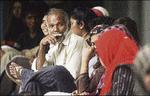
Maldivians await their turn at a polling station in Male, Maldives, yesterday. Maldivians voted in a landmark referendum to decide on a new form of government, a vote hailed as this tiny Indian Ocean nation's first real expression of democracy.MALE, Maldives (AP):
Thousands of Maldivians, many of them fed up with the nearly three-decade rule of Maumoon Abdul Gayoom, voted on Friday at schools and makeshift gazebos in the crowded capital and on remote atolls in a poll seen as a vote of confidence in their president.
The referendum was technically to choose a new form of government. But many here hailed it as their first real expression of democracy and hoped it would lead their tiny Indian Ocean nation to a better future.
"This election means freedom," said Suheil Ismail, 41, after voting in a breezy, open room at a schoolhouse in the capital, Male.
Gayoom is pushing for a U.S.-style political system, with a powerful executive presidency for this Sunni Muslim nation of 300,000 people. The opposition, wary of giving too much power to another leader - or to Gayoom for yet another five-year term - backs a British-style parliament, which would be led by a more accountable prime minister.
Whatever the outcome, a credible poll was expected to clear the way for the Maldives to adopt a new constitution in November and to hold its first multiparty elections next year.
As voting was scheduled to end at 7:00 p.m. (1400 GMT), the main opposition Maldivian Democratic Party complained that many polling stations had run out of ballots and people were still waiting in long lines. Election officials have the authority to keep their polling stations open late if need be.
The party said it had filed 120 complaints about voting irregularities. The ruling party, known locallyas the DRP, complained that the opposition engaged in intimidation, violence and illegal campaigning.
However, at many polling booths in the capital, voting appeared generally calm and courteous, and international observers on far-away islands reported orderly, and brisk, voting.
Voters waited quietly
At the national soccer stadium, voters waited quietly in the shade of the stands for their turn to enter one of the 13 blue voting tents that ringed the field. Outside, scores of the city's ubiquitous motorcycles stood neatly parked in a row, as nearby taxis ferried voters to the polling station.
On the island of Villigili, a suburb of Male, hundreds of people sat in a huge circle of chairs in the courtyard of the local school as they waited for more than an hour to cast their ballots.
Mohamed Shahuneem, 18, said he was going to vote for a presidential system to show his support for Gayoom, Asia's longest-serving ruler.
"We are very happy. It's normal here, because of the president," he said.
Many others expressed concerns that no matter how the vote turned out, the president would not be willing to give up power.
"If this man brings freedom and democracy to us, it will be a miracle," said Adam Maniku, 60, a former deputy finance minister, after voting in Male.
Explosive economic growth
Gayoom - who has won six elections, but never faced an opponent - has led the nation of 1,190 coral islands southwest of India through a period of explosive economic growth, fueled by the 600,000 tourists a year who frolic on the sandy beaches of its remote island resorts.
But he has also been accused by opposition leaders, Western diplomats and international human rights groups of using torture and police crackdowns to stifle dissent.


















