Shelly-Ann Thompson, Freelance Writer
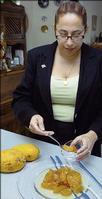
Madai Hernández A., Deputy Head of Mission, Embassy of the Bolivarian Republic of Venezuela, shares some of the dulce de lechosa (papaya dessert), a Venezuelan Christmas dessert. - RICARDO MAKYN/STAFF PHOTOGRAPHER.
Madai Hernández A., Deputy Head of Mission at the Embassy of the Bolivarian Republic of Venezuela, shares her favourite Christmas dishes
WITH DELECTABLES treats such as hallacas, pan de jamón, dulce de lechoza and ponche crema on the dining table, Christmas in Venezuela is definitely a feast.
After Food spoke with Madai Hernández A., Deputy Head of Mission at the Embassy of the Bolivarian Republic of Venezuela, we concluded that Venezuelans certainly know how to celebrate the birth of Christ.
In that country, Christmas is celebrated with a variety of religious and traditional customs. As a predominantly Catholic country, Christmas festivities celebrate the birth of Jesus. The religious celebrations begin on December 16 with Masses said every morning until December 24 when the religious service is held at midnight (Misa de Gallo).
The main feast begins at midnight on Christmas Eve - noche buena - with an immense dinner party. Relatives and loved-ones gather to enjoy traditional holiday meals like hallacas (pronounced a-yá-kas) pan de jamón, and dulce de lechoza.
Pan de jamón is a long bread filled with cooked ham and raisins. The dulce de lechoza is a dessert made of green papaya and brown sugar, slowly cooked for hours and served cold.
BOUNTIFUL MEALS
Christmas Day is celebrated by staying at home with relatives and friends, resting and revelling in the bountiful meals. It takes three days to make hallacas and usually, the entire family is involved in the process. "Hallacas are served after midnight Mass on the best china, along with the best silverware and linens," stated Mrs. Hernandez A. It is made from cornmeal dough and contains spices, olives, wine, and pork, chicken, or beef. The hallacas are wrapped in plantain leaves and boiled to make a pie.
Dulce de lechoza (pronounced Dool-seh deh- leh-chó-sah) is preferred for dessert. It is a type of preserve made with green papaya and brown sugar. This dessert is served after a big meal with sweet cookies and, or white cheese.
Ponche Crema, much loved by Venezuelan women, is the Christmas liquor. Similar to rum crème, it contains sugar, eggs, Venezuelan rum, milk, and cinnamon. Being made since the 1900s, the recipe has been kept a secret with only the main ingredients publicly released. "Without Ponche Crema, there is no Christ-mas," said Mrs. Hernandez A.
Many homes put up a Christmas tree, but the most authentic Venezuelan custom is to display a nacimiento (nativity scene). A more sophisticated nacimiento is the pesebre. This represents an entire region with mountains, hills, plains and valleys. The central point is a replica of the manger at Bethlehem. The structure is a framework covered with canvas and painted accordingly. Often, the pesebre becomes a real work of art.
On December 25, children awake to find their gifts around the nacimiento or the Christmas tree. Tradition has it that it is the child Jesus who brings gifts to the Venezuelan children instead of Santa Claus.
"It's very exciting to see the children's faces on that morning as they laugh and scream about the wonderful gifts they receive." But the gift giving to children is not yet over, as come January 6, they receive more gifts. "A little gift, something smaller, normally candies or chocolates."
MERRIMENT AT CHRISTMAS
Like any other country, music is a part of the merriment at Christmas for Venezuelans, said Mrs. Hernandez A. "Music is very important because it's a traditional music that celebrates the birth of Jesus". Each region of the country has traditional songs of this period called aguinaldos.
Centuries ago, the aguinalderos (singers of aguinaldos) visited homes, singing their songs and playing traditional instruments such as the cuatro (a small, four-stringed guitar), the maracas (rattle) and the furruco (a small, elongated drum with a wooden stick in the middle).
The Christmas festivities come to an official close on January 6, the Day of the Reyes Magos, when the three wise kings came to visit Mary and the infant Jesus.
"Christmas is very exciting. It's a happy time; everybody is happy, it's a beautiful time of the year with special meals, special music, and the streets and buildings are full of lights.


















