
Pig boom - Farmers bring home the bacon as pork production hits 10-year record
Published: Tuesday | March 10, 2009
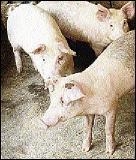
Locally reared pigs are on the increase. - File
PORK-LOVING Jamaicans can break out the party hats and confetti as the Ministry of Agriculture has announced that the island is experiencing a boom in high-quality, locally reared pigs.
Hershell Brown, project director of the Agricultural Support Services Project (ASSP) in the ministry, revealed that 2008 was a record-breaking year for the nation's pig farmers.
"Last year, we im-ported the least amount of pork in 10 years. There is a pig boom," Brown boasted.
In July 2005, it was reported that Jamaica was producing approximately seven million kilograms of pork per year. However, this was unable to satisfy existing demand, resulting in the importation of pork from Canada to fill 23 per cent of the local demand.
The pig-farming industry is reaping the benefits of the $53 million Pig Industry Improvement Project, which was started in 2005 at the Bodles Research Station, Old Harbour, St Catherine.
Launched in 2004
The project was born out of a partnership involving Newport Mills Ltd, Donaldson International (a Canadian livestock genetics company) and the Ministry of Agriculture, through the Agricultural Support Services Project launched in June 2004.
The ASSP contributed $18 million to the project.
The multimillion-dollar improvement project promised local pig farmers access to superior offspring by September of that year. The pork lover's dream came to pass.
"We have been getting larger litters and better birthweights and animals that grow faster," Brown said.
The bid to achieve a superior stock was started with 75 young sows, which were bred by 190 pure-bred pigs imported from Canada in September 2004. The pigs were housed at a state-of-the-art breeding facility, which was outfitted with automatic watering and feeding systems in operation at Bodles.
The facility also boasts a modern artificial insemination laboratory that has been producing and selling semen from the pure-bred animals since March 2005.
Quality was poor
Prior to the intervention, the quality of pigs on the island was very poor due to widespread inbreeding.
"The pigs we had in Jamaica were really run-down ... . The quality of the animals was actually very poor," he said. Farmers have been trained to perform artificial insemination.
Brown believes this is a pivotal aspect of the pig-farming improvement project. "And, very importantly, they can buy semen to impregnate pigs that they have out in their fields," explained Brown.
According to him, the tech-nologically advanced procedure is not rocket science.
"It's quite simple and with very basic training the farmer can do his own insemination."
Farmers pay for the pig semen, but the training is free.
tyrone.reid@gleanerjm.com