
Trinidad plans bond issue to cover shortfall
Published: Wednesday | January 21, 2009
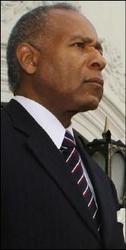
Trinidad's Prime Minister Patrick Manning says he will run a fiscal deficit this year. - File
Trinidad and Tobago has announced plans to tap the domestic capital markets for cash through bonds issues to cover the widening revenue gap in its budget as oil and natural gas prices decline.
Other major commodity exports - ammonia, methanol and steel - have also fallen significantly.
Prime Minister Patrick Manning said last week that the new forecast was for a further US$476 million decline in revenues, forcing another round of budgetary adjustments.
Government is now projecting 2009 revenues at US$7 billion - a 12.5 per cent adjustment compared to the original US$8 billion - based on projections for US$45 per barrel for oil as referenced by West Texas Intermediate Index and US$3.25 per mmbtu for gas, representing Henry Hub prices.
"The government will issue bonds in order to finance the deficit without compromising our economic fundamentals," Manning told lawmakers at a parliamentary sitting.
"We are able to do this because over the years, we have realised a significant build up of savings as well as growth in our foreign reserve position which could more than adequately meet the necessary repayments on our sovereign debt. Given the existing high liquidity environment, we are certain that this can be done exclusively on the domestic market."
But Manning said expenditure cuts alone cannot compensate for the projected shortfalls.
"We have consequently decided that we will employ a two-pronged attack," he told Parliament.
"We will continue to trim expenditure; and recognising that we cannot totally compensate for the revenue shortfall, we will also run a temporary deficit. That is to say we will fund a part of our expenditure out of savings."
'Limited deficit financing'
Manning did not say when the floats would occur nor the target debt to be raised for his treasury.
The 'limited deficit financing' and the adverse export outlook, he told Parliament,would not affect exchange rate stability. The currency remains at TT$6.30 to the US dollar.
The country's US$9.2 billion of official reserves, the equivalent of 11 months of imports, is available to moderate any exchange rate fluctuations, he said.
Last November, the Prime Minister in a public broadcast told Trinidad he was suspending several public sector construction projects, at a time when revenue shortfall was projected at US$117 million.
To date some eight per cent of the original figure has been trimmed, he said.
The impact of the global crisis has been felt in weakening stock market activity in the last quarter, a softening in the real estate market, decline in retail sales during the Christmas season, postponement of some private sector investments, the continuing temporary closure of the plants in the domestic energy sector and the postponement of new plants in the energy sector which were carded to begin construction this year.
In efforts to reduce inflation, Manning said there has been a sizeable increase in interest rates which has had a noticeable effect on both consumer purchases and business credit expansion.
Repos are at 8.75 per cent, prime rates at 13 per cent.
"However, these trends, if taken too far, could contribute to a marked slowdown in private sector activity and a rise in unemployment," said Manning.
"In addition, due to prevailing circumstances, it is very possible that oil and gas prices in 2009 could fall even lower than the revised projections made in late November 2008," he said.
Oil is trading at US$35 to US$40 per barrel, but energy analysts are already projecting US$25 oil this year.
The good news is that the fall in world commodities, particularly food, has already led to a reduction in the rate of inflation for the twin-island republic.
Annual inflation was 14.3 per cent in November, down from 15.4 per cent in October.
"Therefore, further measures to tighten the system may not have to be instituted, thereby easing the interest rate pressure presently existing in the system," Manning said.
The country is faced with weakening demand from its trading partners, and the prime minister hopes to plug that gap by stimulating domestic demand and maintaining jobs.
Weakening export demand
"We are convinced that with the global recession impacting on local private sector confidence, and with weakening export demand from our Caribbean markets, the Government has the responsibility to maintain an adequate level of domestic demand," he said.
Trinidad's economy grew an estimated 3.5 per cent in 2008, two points lower than the 5.5 per cent in 2007.
However, growth in the non-energy sector remained robust, at about 8.0 per cent.
The unemployment rate fell to a historical low of 4.5 per cent by the second quarter of 2008, which meant that for every 100 persons in the labour force approximately 96 persons were employed.
business@gleanerjm.com