
Agriculture Today: The buzz about farming - Bee farmer enjoys success from expansion
Published: Saturday | January 10, 2009
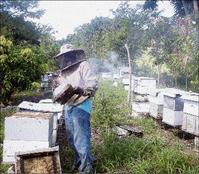
Bee-keeper Donald Walker checks honey production on his bee farm in Yallahs, St Thomas. - Contributed
"You can make it if you try," those are the words of 35-year-old Donald Walker as he reflected on the remarkable success he has had as a result of agriculture.
Walker, a resident of St Thomas, explained that agriculture is in his lineage, as his father calls this noble field his profession.
That aside, he pointed out that years ago at age 16, to be exact, he was on a journey, contemplating what he would do with the rest of his life and the one constant was agriculture.
The business of planting fruit tree crops and ground provision, among other agricultural items, is now a lucrative venture, so much so that he does not have hands to sell the produce reaped from his seven-acre holding.
Expansion
Naturally, the avid businessman seeks ways in which to expand production, and Walker is no different.
Not expansion of acreage or crops, instead he ventured into world of bee-keeping.
Walker explained that he started bee production some 16 years ago with only one box of bees and those that he had removed from trees in his yard.
However, for some unexplained reason the bees started dying and so were his profits and faith.
Learning from failures and injecting more money in what could be a profitable business, Walker brushed himself off and got back into production.
Now, he has over 70 colonies that produce honey up to six times per year.
The commodity is in great demand, so much so that the product is completely sold even before it is harvested.
"I even get orders for the honey before it is ready," he said.
In great demand
"Persons are constantly calling me to acquire the product," he added.
On a normal day, Walker says he can harvest more than 90 gallons of honey, which is supplied to community members, grocery stores and community markets.
Another factor he attributes to the burgeoning success he enjoys is that St Thomas is now able to produce honey up to six times per year, compared with other parishes that can harvest the commodity only twice yearly.
In a bid to expand production to some 1,000 colonies within the next five years, Walker explained that profits earned from the sale of honey goes into the purchasing of inputs for the five-year expansion timeline.
"I know I can get there if I just continue to work hard, I know I will get there. By early next year, I should have at least 150 or 200 colonies which will add up," he said.
"I try to get some material and store them in order to expand production capacity when that time arises," he added.
"To tell you the truth, I love both crop cultivation and bee farming," said Walker when quizzed about the transition.
"I do not specialise in one over the other because I love both areas," he continued, while pointing out that if one aspect failed, then he could still earn an income from the other.
In order to become a bee-keeper, Peddy explained that a number of aspects must be scrutinised such as the general location of the farm to determine carrying capacity, a site visit must be conducted by the unit and all individuals must undergo initiation training.
You can make it if you try
"I have been talking to young persons and I have always told them you can make it if you try. The more independent you are, the better you will feel as an individual, therefore farming is the way to go," Walker maintained.
Although yields are high and bee-keeping is a lucrative venture, Walker said bee-keepers in his area were severely plagued by the beagle bug or small hive beetle, known by the scientific name Aethina tumida.
However, checks with Reginald Peddy, chief plant protection officer in the Apiculture Unit, revealed that for those farmers being affected by the insect, help is on the way, as the unit was currently conducting research on a number of insecticides to ascertain their effectiveness.
"There are some insecticides that are now being looked at, but we have not been able to come up with any other that we would want to recommend at this time," said Peddy.
Hive beetle larvae
In the interim, farmers should continue to use the Sevens Power, which is readily available islandwide since this is an effective insecticide in ridding their colonies of the hive beetle larvae.
Additionally, Peddy said, the Apiculture Unit is at present in the process of constructing and issuing 1,000 model hive beetle traps to be used as part of the detection and removal process.