Mark Titus, Enterprise Reporter
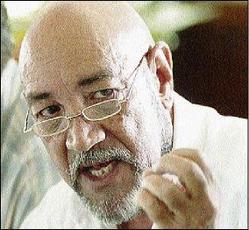
Allan Rickards ... If this divestment was to falter, we will not be accepting closure as an option. - File
The Jamaica Sugar Cane Growers' Association (JSCGA) is paying keen attention to the outcome of current talks involving Infinity Bio-Energy Ltd and the Jamaican Government, as it is prepared to manage the factories up for divestment should present discussions fall through.
"We are eyeing this situation very carefully," said Allan Rickards, JSCGA chairman.
"If this divestment was to falter, we will not be accepting closure as an option," he added.
According to Rickards, his group would, in such a situation, approach the Government for the opportunity to take charge of the beleaguered industry. He is confident that the growers' association's knowledge of the industry would help it succeed.
He argues that if the perks being given to the Brazilians, including tax and duty concessions, and the money to be spent on the redun-dancy and relocation exercises were offered to JSCGA, the factories could be managed efficiently.
"That funding made available to us to keep the industry going would make us succeed," he said.
"When workers are laid off, they get redundancy payment and can go into other businesses, but when a factory closes, the farmer is left to look on his cane, there is no redundancy," he pointed out.
Inefficient industry
While acknowledging that the Government could not afford the kind of capital necessary to achieve viability, he contended that Jamaica, once the leading producer of the sweetener globally (513,000 tonnes of sugar in 1965), should not have been allowed to become the inefficient and state-dependent industry it is today.
Drawing comparisons to the privately owned Appleton Estate in St Elizabeth and Worthy Park in Clarendon, Rickards argued that even in difficult times these facilities were able to function with a fair degree of efficiency. The state-owned institutions, on the other hand, with less emphasis on viability and production, fell off the radar.
"There is a difference between a manager of a state-owned opera-tion versus a privately owned factory," he said. "One knows that they have to produce, but the other operates knowing that he will be paid whether or not he produces," he added.
Lamenting the present state of the industry, Karl James, head of the Jamaica Cane Products Sales Limited, believes that poor decision making by the State contributed to the industry's dramatic decline.
"We went wrong in the '70s when we decided to turn the major sugar factories into cooperatives," he told The Gleaner.
"In Jamaica we seem to think that cooperative means that everybody becomes manager, everybody becomes owner, but a sugar industry is a very complex industry, you need technical people, astute management to run it. We went wrong from then and have not recovered," he explained.
No agricultural policy
According to James, king sugar's demise has also come because of the non-existence of an agricultural policy.
"We really need to have a serious policy where we support agricul-tural production from the begin-ning right up to marketing and, most importantly, we must take the politics out of it and make it a business."
Government agreed to divest its assets in the Sugar Company of Jamaica (SCJ) to Infinity Bio-Energy in late June last year. It will not receive cash for the sale, but a 25 per cent stake of the assets for three years, valued at US$25 million (J$1.8 billion). The assets were expected to be fully transferred by September 30, but negotiations continue.
Under the agreement, Infinity Bio-Energy's core focus will be on ethanol production and will produce 80 million kilolitres of ethanol within two years, and 135 million by 2013. It will simul-taneously improve sugar-cane production from 1.4 million tonnes in 2009 to 2.5 million by 2013.
A decrease in sugar output
Its operation will also include a 138-gigawatt co-generation project by 2011. This will increase to 168 gigawatts of electricity by 2013. Infinity's operation will, however, see a decrease in sugar output, from 125,693 tonnes in 2009, to 62,000 tonnes in 2010.
The Infinity divestment is the second attempt by the Government to divest the SCJ. The former People's National Party adminis-tration, led by Percival James Patterson in the 1990s, divested the company to a consortium of local entities and a British company, Booker Tate. That deal fell apart, however, after a few years when the purchasers said the Government had failed to meet its commitments under the agreement and that its economic policies and actions to allow the revaluation of the Jamaican dollar made the business unprofitable.
mark.titus@gleanerjm.com
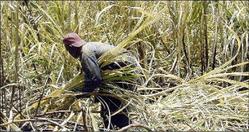
A sugar cane cutter employed to the St Thomas Sugar Company in Duckenfield, St Thomas, harvests cane for milling. - Gareth Manning photo