Farmers hurt by fertiliser hikes welcome imports
published:
Wednesday | November 5, 2008
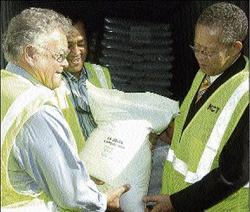
Prime Minister Bruce Golding (right) examines a bag of fertiliser at Port Bustamante, Kingston, on October 24. Joining in the inspection are Industry Minister Karl Samuda (left) and Agriculture Minister Dr Christopher Tufton. The fertiliser was imported by the Government to provide it at cheaper cost for farmers. - Norman Grindley/Acting Photography Editor
The cycle of spiralling fertiliser costs since January has hurt many farmers, while sending others back to basics.
"The arrival of the imported fertiliser will lead to a significant increase in production in the short-term," said Mark Lee, a young St Elizabeth farmer.
Like many of his fellow farmers, the downturn in production resulting from the cycle of fertiliser price increases made it necessary for him to lay off workers. However, as things got harder, he went back to nature, using organic fertiliser.
"I started to raid my friends' chicken coops, and I also used the fact that my farm is near to Appleton Estate to buy organic fertiliser (by-products from processed sugar cane) from them, without exorbitant transportation costs. All this has made the application of nutrients to the soil more labour-intensive, but the substitution is working out well for me."
Where he was applying a 100lb bag or more of the commercial variety per acre, he is now using half a bag, supplemented by organic fertiliser. This has slashed his expenditure on fertiliser by about 40 per cent.
President of Mavis Bank Co-operative, Titus Minott, confirmed that the meteoric price hikes had taken a toll.
He recalled that in January of this year, members were paying approximately $4,500 for a 50lb bag of fertiliser. However, as recently as last Friday, the cost of this blend from the local supplier was $7,600.
No more animal manure
"This has sent many of us back to using animal manure and composting," Minott explained.
Despite their efforts, more than half the 44-member cooperative have had to cut back on production by as much as 75 per cent.
"I used to plant five squares of cabbage and tomato, but since the fertiliser price began to skyrocket in January, I have only been able to replant two squares," said Minott. He said he had 2,000 cabbage seedlings in storage, but was unable to afford the five bags of fertiliser it would take to see them through to fruition.
However, Government's announcement recently that it had sourced cheaper fertiliser overseas has brought welcome relief.
"Now that the Government is bringing in fertiliser at a price that we the farmers can afford," he says, "we will be able to return to our former levels of production. And if the prices are sustainable, the co-op intends to expand into new markets."
Leroy De la Haye, who produces vegetables on a 10-acre plot in St Catherine, welcomes the imported fertiliser.
"It will inject energy back into the sector," he declared.
With the current price of the local blends, De la Haye estimates that it is now costing the average farmer as much as 100 per cent more to produce the same volume of crops when compared to same period last year.
Production Analysis
A costing of production analysis carried out by the Ministry of Agriculture using 12 crops targeted for productivity enhancement shows the reduction in production prices which can be achieved using the imported fertiliser blends purchased at the recommended retail price.
According to Agriculture Mini-ster, Dr Christopher Tufton, these crops have been selected for a productivity improvement programme, based on market demand in the retail, hospitality and agro-processing industries, following an end-user analysis carried out by the ministry's marketing division.
The ministry, he said, is providing incentives and technical support to registered farmers' groups engaged in the cultivation of these crops, with the aim of improving local productive capacity.
"With fertiliser being one of the critical inputs necessary to ensure optimum productivity levels," Tufton noted, "the success of the Government in sourcing this commodity at significantly lower prices than the local blends is a watershed achievement for the sector."
New fertiliser costs
Crop
Fertiliser used/acre
Old cost of
New cost of
% Change
Direction
production/lb
production/ lb
of Change
Carrot
445 lb (4 bags)
$7.36
$6.35
13.74
decrease
Dasheen
834 lb (7.5 bags)
$18.61
$16.86
9.41
decrease
Scallion
3,322 lb (30.2 bags)
$38.78
$34.65
10.66
decrease
Ginger
311 lb (2.8 bags)
$49.09
$44.27
9.81
decrease
Hot pepper
3,850 lb (35 bags)
$41.58
$35.91
13.64
decrease
Irish potato
1,113 lb (10 bags)
$19.16
$15.69
18.13
decrease
Onion
806 lb (7.3 bags)
$20.72
$18.07
12.78
decrease
Red peas
668 lb (6 bags)
$159.04
$133.74
15.91
decrease
Sorrel
445 lb (4 bags)
$98.51
$85.32
13.39
decrease
Sweet potato
668 lb (6 bags)
$6.12
$4.97
18.79
decrease
Tomato
2200 lb (20 bags)
$15.84
$12.77
19.35
decrease
Yellow yam
1,113 lb (10 bags)
$11.29
$9.90
12.37
decrease
'The success of the Government in sourcing this commodity at significantly lower prices than the local blends is a watershed achievement for the sector,' says Tufton.