The Editor, Sir:
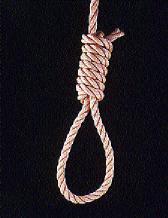
The subject of the death penalty is like a recurring decimal in this society because we are so divided on the issue, and successive governments have been unable to divide the crime rate by any wholesome application of agreed upon measures. The question is: Should hanging be used as a tool in the attempted reduction of crime, or should it simply be a means of natural justice for the brutal act called murder?
Retrograde step
Human rights activists proclaim that the killing of one human being does not justify the killing of another as punishment, and only serves to perpetuate the act of killing as the 'solution' to conflicts - a retrograde step in society's progressive agenda and no real deterrent to crime. On the other hand, those who support capital punishment will point to the Bible as reference, and some hold true to the mantra: 'if him dead, he can't kill again'.
My views on the matter are philosophical, yet very simple. I support capital punishment, not as a deterrent to crime first, but as the ultimate price for any human being to pay for murder. The deterrent must be seen as a consequence of, not as the main reason, for such laws.
For instance, if incarceration proves useless in driving down the crime rate, do we then argue for abolishing incarceration and making referrals to a state psychologist since incarceration can also trample on the rights of the innocent, and has failed as a deterrent to crime; or do we seek to improve the weaknesses in the system? Do we advocate for the police force to stop carrying guns since there is the possibility of collateral damage in their quest to 'serve and protect' as has happened a few times? or do we seek to improve their skill sets and rules of engagement?
SELF-DEFENCE
Now, the fundamental and most basic right of all human beings is the right to peaceful existence on Earth. To realise this right, every human being further has a right to self-defence, encompassing his life, family, and property. Therefore, the act of killing an individual in self-defence is not murder, but is merely an act of self-preservation.
The role of the State is triggered, however, when an individual's right to self defence has been denied by his/her attacker in realising the death of the said individual. The State, in this instance, must act on behalf of the victim by executing the ultimate punishment. Failing this, the State would have abrogated its responsibilities, thus aborting the process of natural justice.
Life has little or no value to those who offensively take life and are not prepared to give up their own as a consequence of their actions. Think about it; what is to prevent someone terminating your existence if the balance of power is so heavily weighted in his/her favour, where the consequences of such actions are not equally weighted even when the perpetrator is caught.
There are those who will argue that innocent persons may get caught in the capital punishment dragnet and the finality of death precludes any future chance of freedom for such persons should supporting evidence avail itself.
There is, however, only one perfect system on Earth - the system of inequality. So, while we attempt to minimise the injustices faced by society, let us not do it at the expense of the majority of law-abiding citizens. So, to eliminate the death penalty because there is the possibility of the State killing the wrong person is to suggest that wars should not be fought since civilians not directly involved may get killed.
ROLE OF THE STATE
The State must, therefore, move with alacrity and fix the ills of the justice system to minimise the collateral damage of finding the innocent guilty. It must also move towards the reformation of the police force such that, their problem solving and investigative skills will increase the probability of criminals being caught.
More important, though, the State must empower its citizens to be able to appropriately defend themselves at the point of contact with criminals, by allowing more liberal laws in the granting of gun licences.
I am, etc.,
KARL JOHNSON
Kingston 6