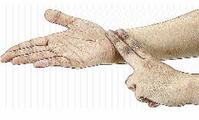
Our heart rate, or pulse rate, is one of the most efficient ways to assess the effect of exercise on our bodies. The pulse can be measured at the artery on the side of our neck (just below our jaw) with the use of our middle and index fingers. Either finger can be used if that feels more comfortable.
The pulse can also be located on the front of our arm, just above the wrist. If we are having difficulties identifying a pulse at the locations mentioned, the side of our forehead above the ear or the temple should provide us with one. A last resort is to place our fingers over our heart and count the beats. Once we have located a beat, gently press both fingers on the spot and count the number of beats, for a period of 10 seconds, then multiply that number by six. The result is our pulse rate for one minute, or we can simply count the number of beats for one minute.
To get our resting pulse rate, we can do a reading in the morning as soon as we get out of bed. This should give you an ideal reading. We should do at least three readings, which can then be averaged to establish a valid rate. This resting pulse rate is needed to establish our baseline for the readings that will be done in the future to monitor our progress and chart future changes in our exercise programme. It will give us an indication of how our resting pulse rate compares with the changes that take place during exercise.
The maximum rate
Pulse readings should be done at intervals during exercise, so that we can monitor our input in the activity and our body's response. A pulse reading should be carried out within five seconds of the end the session. This also provides a baseline to determine how long it takes for our recovery, which is important diagnostic information.
Our maximum pulse rate is important information that we need to know. One way we can assess this is to count the pulse beat as soon as we have completed a session of strenuous exercise. This will give us a good indication of how much we are capable of doing. We can also predict our maximum pulse rate by subtracting our age from 220.
The ageing factor
The difference between our maximum pulse rate and our resting pulse rate is our pulse rate reserve. This provides us with a good guide for the level at which we should maintain our pulse rate during exercise. We should try to maintain our pulse rate between 50 and 85 per cent of its reserve, during exercise, to achieve and maintain cardiorespiratory fitness.
As we age, our maximum pulse rate decreases, thus we do not have to exert ourselves as much to experience the benefits of exercise. However, the improved benefits we enjoy may push us to exert more effort and exercise harder, which will elicit further improvements.
Those who are at risk for exercise-related health conditions should be monitored so that safety precautions are not compromised. Exercising in the reserve zone will optimise the exercise benefits as well as provide built-in safety factors to prevent unnecessary stress. The lower our level of fitness, the lower the intensityof our exercise. This will facilitate longer sessions and the possibility of greater improvement.
Dr Kenneth Gardner is an exercise physiologist at Holiday Hills Research Center; email: yourhealth@gleanerjm.com.