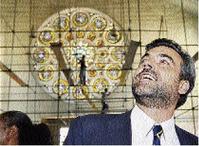
Spain's Ambassador to Jamaica Jesús Silva examines the roof of the refurbished Holy Trinity Cathedral on North Street, central Kingston.- Kyle Macpherson/Freelance PhotographerThe refurbishment of the Holy Trinity Cathedral on North Street, central Kingston, is being billed as a model of community involvement, historical preservation and religious renaissance.
Constructed in 1814, the cathedral is one of approximately 20 churches across Jamaica which have been declared national heritage sites. It was reconstructed in 1911, following the 1907 earthquake.
With help of the men and women from North Street, Spain's Ministry of Culture and the Edna Manley College of the Visual and Performing Arts, 3,000 square feet of artwork on the walls, originally created by German/American artist Francis Schroen, a Jesuit brother, in 1911, will be refurbished. It is the newest effort to return the cathedral to its former glory.
It was in 1998 that Archbishop Edgerton Clarke established a committee to guide the process of restoring Holy Trinity Cathedral. His work has been continued by subsequent archbishops, including current prelate, Archbishop Donald Reece.
Restoration of the artwork commenced in April 2008 with the hope of completion by December 2008.
The challenge of restoration involves the removal of three layers of grey paint covering the original paintings.
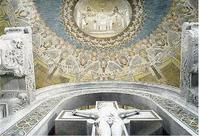
A section of the refurbished Holy Trinity Cathedral on North Street, central Kingston. Restoration of the cathedral, billed at US$2 million (J$140 million), is under way. Spanish restoration expert, Professor Antonio Sanchez-Barriga, volunteered his services to the project.- Contributed
special technique
Thirty-four young men and women from the community (forming morning and afternoon teams, daily), students from the School of Visual Arts at the Edna Manley College, and members of HEART use the special technique of paper towels and thinner to remove the overlay.
The proces is overseen by Father Kenneth Richards and representatives from the Spanish Embassy, to ensure successful progress. Professor Antonio Sanchez-Barriga of the Spanish Embassy has expressed the belief that the restoration of the church will have positive impacts on the church and the wider community.
The restoration, he said, is "very important because artistic heritage is being restored to the standard of the 20th century".
It is also his opinion that people who live close to the cathedral, and visitors, will enjoy the art, which is a possible tourist attraction.
Father Kenneth Richards states, "For the religious community, religious art inspires a sense of God, a sense of worship, a sense of the presence of God. The Byzantine structure brings a sense of the closeness of God on earth."
This presence of God is revealed in the already-restored artwork in the cathedral's sanctuary, which portrays the Holy Trinity of Christianity - Father, Son and Holy Spirit - seated on the heavenly throne and surrounded by the angelic choir.
Other restored art in the church shows the four writers of the New Testament Gospels: Matthew, Mark, Luke and John, and also shows the artistic designs of some of the walls that create a sense of reverence.
More restoration
As more of the walls become unsheathed, (including the dome area, which has been severely damaged), other areas of the cathedral will be renovated in the restoration process.
The organ, which was donated by Colonel Ward (who also donated the Ward Theatre), is also being restored.
To facilitate this, three Jamaicans have been sent to Germany to learn the art of organ building. These individuals include a member of the surrounding community, an expert and a member of the Spanish Town community.
The stained glass windows in the cathedral, which were destroyed by Hurricane Charlie in 1951, are also being replaced and the original tiling in the sanctuary will be covered with acrylic for historic preservation.
The Holy Trinity Cathedral has involved those who live nearby in the restoration process, and is poised to continue its intense community outreach in collaboration with the Downtown Ministers' Fraternal, of which Father Richards is the current chairman.
Weekly community walk-throughs during violent upheavals and street-side services are some of the activities that the cathedral remains committed to. The TPDCo (Tourism Product Development Company) will be training members of the community as tour guides, to help establish Holy Trinity Cathedral as a tourist site.
Father Richards expressed his gratitude to the many benefactors who have assisted with the restoration project.
In praising the youth of the community, Professor Sanchez-Barriga said that "The boys from the community are learning very fast, and they work very hard and are very committed."
As the 21st century continues to unfold, Father Richards hopes that "citizens will develop respect, patriotism and responsibility. The Church has a role in re-establishing such values".
According to Father Kenneth Richards, the restoration effort will unveil a cathedral with unique architecture and art.


















