It has been accepted in several quarters that the happenings of Saturday, September 20, provided a welcome fillip for the People's National Party (PNP).
It was the day on which the entitlement to the presidency of the party, certainly for the immediate future, came to be in question no longer.
But, even before the announcement of the winner of that contest, there was much reason for celebration and pride in the atmosphere that prevailed on the grounds outside the National Stadium and within the National Arena.
Comrades and their friends interacted and conversed, and even campaigned in the manner of the 'ole time' fair or garden party.
If a stranger had parachuted into the centre of those happenings, it would probably have taken some time for him to recognise that what was taking place was the exercise of their privilege by delegates of an organisation to fill a key position on the Jamaican political landscape.
Lesson in discipline
The day itself presented a lesson in discipline, tolerance and caring. As human beings, those who were there would have had pent-up feelings, frustration, fear and hope of political fortune. All these sentiments, and more, appeared to have magically taken a back seat to a comradely and accommodating sense of what is possible and, indeed, what is required.
Some maintain that this was part of the silver lining behind the dark clouds that had formed during the campaign; the other part being that the party would be energised.
And so, September 20, 2008, a mere two days beyond the 70th anniversary of the founding of the oldest surviving party in Jamaica, is a day that will find a solid place in its rich and colourful history.
It constituted the end of the beginning of a new chapter in the annals of the party. The beginning of that chapter had been signalled by an announcement by Dr Peter Phillips, a vice-president of the party, that he was about to seek the position of the presidency.
There was some drama surrounding that announcement early in the night of Sunday, July 13. For, moments into his speech, an earthquake shook parts of Jamaica, including Harbour View to the east of the capital, where he and other comrades had gathered.
As far as interpreting what that omen portended, some say one thing, some say another; but none will deny or ignore the drama of the moment.
The announcement itself brought two views immediately to the fore. The first was that: regardless of the fact that no incumbent president had ever been challenged during these past decades of the party's existence, there was no rule that would prohibit such a challenge from being mounted
The other view was that: conceding that such a right does exist, there is the requirement that it must be exercised with due regard to prevailing circumstances which, it is said, all adds up to what is called 'appropriate timing'.
The first view - that there always exists a right to challenge - was reinforced by the assessment that the incumbent, Mrs Simpson Miller, was a minority leader, since she did not receive a 50 per cent plus one majority in the contest two years ago involving herself and three others, including Dr Phillips.
The second view, which appears ultimately to have prevailed, was reinforced, inter alia, by the closeness of the plurality and the seat count in the general election of September 3, last year, the outcome of which is still in question.
It is within that framework that the contest took place and it is common knowledge that it was conducted, in too many respects, in an uncomradely and uncalled for way of doing things.
Healing necessary
No one doubts, therefore, that there is the requirement of healing in the PNP. Fortunately, for the party, there are certain circumstances in place that will help to strengthen the platform from which that healing process ought to get under way in earnest.
The manner in which the delegates and other Comrades went about their business on Saturday, September 20, is acknowledged to have assisted greatly in the movement forward of that process.
And it is clearly not unhelpful that the party is not shown to be behind, or moreso far behind, in any poll conducted in the recent past. Indeed, the polls strongly suggest that it enjoys a not insignificant lead over the governing party.
It is also conceded that the healing process would have been far more difficult to get off the ground if the day of voting had been marred by unfriendly behaviour.
And it is certainly far less challenging to persuade the membership to listen to the voice of reason when they are buoyed by the kind of fillip that is provided by some sign of a positive view of their party and their party leader among the general populace.
Across the sweep of these past 70 years, the force of unity in the PNP has always been erected upon the foundation of 'a charge to keep' for the general upliftment of our people. And this has been so, whether in opposition or as the party that forms the government.
For example, adult suffrage and the attainment of internal self-government were the motive forces that influenced the united efforts of the stalwarts and the general membership, even before the party enjoyed its first success at the polls in a general election.
And the revolution of the education system and the drive towards independence provided the platform for consensus-building during the first PNP administration.
For today's challenge to the party, political education must be resurrected, and set about 'with a vengeance'. This is required not merely for the strengthening of the party, but it is an exercise that is necessary to guide the approaches that must be adopted by the people of Jamaica for survival in the turbulent global conditions that threaten to persist for the foreseeable future.
Political education
It is political education that will drive the party to strengthen the integrity of its structures, including the proper functioning of its groups and the workings of its councils.
It is political education that will give meaning to the push for healing and working as a united force, by creating an understanding that these types of initiatives are not an end in themselves, but means to the end of remaining an organ which is essential to the creation of the just society in Jamaica.
It is political education that will inform the sensible and strategic utilisation of the talents and gifts of the membership of the party, including its leaders.
These, then, are real challenges to the PNP as it embarks on the 71st year of its career through history.
New focus
Whether in opposition or as the party that forms the government, there are certain tasks that must form part of the mission of the PNP. That institution must always be at the forefront of initiatives geared towards Jamaica completing the circle of independence.
A PNP opposition has a duty to keep a steady focus on moving Jamaica to the position of having its own indigenous head of state. It is an area of the party's mission that remains unfulfilled.
The PNP must recommit itself to a reform of the independence constitution. Some will say that they are frustrated by the staggered process and progress of that initiative. The PNP cannot afford the luxury of retreating into such a corner of frustration. The goal must be reached, regardless of the hurdles.
The PNP, in opposition, is obliged to buckle down to providing Jamaica with a programme relating to the conservation, and the finding and employment of new sources of energy, one of the compelling challenges of the age.
Issues relating to energy and the preservation and protection of our environment must receive the keen attention of the PNP opposition. And, it should consider the diminishing returns that are bound to flow from wasting its own energy on bickering.
The forums of the opposition PNP would do well to embrace the breadth of the positive contribution and the real possibilities of sports and music to the development of our people.
How are sports and music halls of fame and excellence to be established to record and showcase the potential and the possibilities of the streams that have placed our country on the global map of excellence? How are these landmarks, projecting the heights to which we are capable of reaching as a people, to be put in place as an inspiration, in particular, to our young people?
Priceless asset
These are but few of the questions that must find space and answers in the deliberative processes within the PNP. So, the PNP knows what is required. There is much goodwill in the society towards the party and its leader. This is a powerful asset that must not be made light of, and certainly must not to be squandered.
The PNP has had four leaders, none of whom has had all the skills and talents; none of whom has been, or could have been, perfect. Norman Manley was a visionary who, it is said, paid an unusual amount of attention to detail. He never possessed the charisma of his successor.
The inspirational Michael Manley was not blessed with the organisational skills of P.J. Patterson, who has never made any pretensions in the direction of the charisma of his immediate predecessor as president.
None of those three leaders would make any claim to the natural and unquantifiable love and admiration that flows from such a sizeable portion of the Jamaican society towards Simpson Miller. By the same token, she would, and ought to, admire the gifts that were possessed by her predecessors.
All of the assets of these leaders have been priceless. They have all had weaknesses; that is the inevitable conclusion of the study of mankind.
It is, then, for the membership and the leaders of the PNP to find the right chemistry and the synergy that sends a signal of positive energy. Activating the accepted recommendations of the Professor Meeks-led appraisal committee is a rational and appropriate platform from which to build on the fillip that recent events have so fortuitously provided.
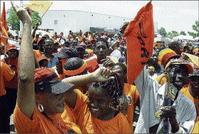
Supporters of the People's National Party at the 70th annual conference held at the National Stadium on Saturday, September 20. - Peta-Gaye Clachar/Staff Photographer
A.J. Nicholson is Opposition spokesman on justice. Feedback may be sent to columns@gleanerjm.com.