Robert Buddan POLITICS OF OUR TIME The re-election of Portia Simpson Miller as president of the People's National Party (PNP) tells us some important things about the role that ordinary Jamaicans, acting as party delegates, play in our political system and how the political system works. They defy some long-held beliefs about the nature and direction of power and how it flows in the system.
Carl Stone laid the basis for much of these beliefs. He formalised the view that Jamaican society works by clientelism and patronage.
Politicians and their parties use government and private resources to buy support. While class differences exist, the difference in the structure of opportunities is determined not so much by class, but by party loyalty.
Thus, the term 'tribalism' has become popular for accusing politicians of only taking care of their own. It means that those who have power and resources give favours to those who are members of their group. The way to get ahead is to 'play politics'.
WHAT STONE SAID
Carl Stone wrote that, "The dominant basis of political allegiance in a clientelistic party system is personal loyalty to individual political actors who have or are perceived to have high capability to allocate and distribute divisible material and social benefits as well as indivisible sectoral class or communal benefits."
Further, "The top leadership of the two political parties in Jamaica, including the party leaders, the parliamentarians, and the principal party officials, are essentially patrons or political bosses. The middle-level leadership of activist party organisers and local government officials are primarily brokers or intermediaries who provide the points of contact and communication in the spoils system of benefits distribution, promising rewards or actually allocating them".
There is a maximum leader who has "near absolute power to bestow rank and standing in the pecking order. Individual survival and mobility up the ladder of power depends on careful cultivation of the goodwill and support of the party boss or leader, which demands unquestioning personal loyalty".
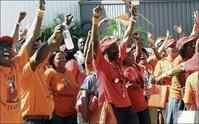
Team PNP supporters in a jubilant mood as their candidate, party president, Portia Simpson Miller, enters the National Stadium on Saturday, September 20, to participate in presidential elections. - Ian Allen/Staff Photographer
WHAT CLARKE FOUND
Daphne Clarke of the Department of Government at the University of the West Indies studied the votes of PNP delegates in the 2006 leadership contest and much of what she found causes us to rethink Stone's 1980 version of things.
What did Clarke's sample find?
For the first time, we know something about the party delegates. They are not merely 'clients' whose interests are as materialistic and whose thinking is as opportunistic as the term makes them sound. They are real people whose characteristics help to tell us about who has power in Jamaican parties. Most (79 per cent) PNP delegates in 2006 were between 33 and 62 years. This is the politically active class. Another 16 per cent were between 18 and 32 years.
Most delegates were of the lower class, judging from the income they earned. Some 30 per cent earned between $10,000 and $30,000 a month. Another 21 per cent earned higher incomes of $71,000 and over.
The lower-middle class was the fewest, those earning $51,000 to $70,000 making up 14 per cent.
Personal choice
One of the most telling findings was that nearly 90 per cent said they voted for a candidate on free personal choice. Just under eight per cent said they were influenced by their MP and just about four per cent by someone else.
The clientelist thesis would have had us believe that these delegates of the lower levels and lower class of the party were instruments of the more powerful and resourceful patrons who had favours to give.
However, an overwhelming majority said otherwise. They voted on their own free will. Slightly more women showed this independent mind.
Middle and upper-class delegates claimed to have been able to exercise the greatest free personal choice (96 per cent) while between 81 per cent and 85 per cent lower and lower middle class delegates reported free choice. More lower class delegates (14 per cent) were influenced by MPs and four per cent by someone else. In contrast, nine per cent of the lower-middle class was influenced by an MP and six per cent by someone else.
Only four per cent of the upper middle class was influenced by an MP and only one upper class delegate was influenced by someone else. There were 23 upper middle class delegates and 38 upper class persons in the sample.
It is not known whether the influence on the lower and lower-middle-class delegates, limited as it was, could have been explained simply by deference or won by inducement.
Probably, it was a bit of both. The comparatively greater level of independent decision-making by the upper-middle- and upper-class delegates could also be explained by a lower sense of deference to their MP and lesser power of inducements over them.
It appears that, while Jamaica is a class society, we must be careful about the claims we make about how much one class of people can influence another and, therefore, how much class power they exercise if other classes do not want them to exercise that power.
PATRIARCHY
Stone studied clientelism in relation to party structure, and class and community voting. He said very little about gender, but his conception of the system of clientelism seemed to assume the existence of a patriarchal society in which maximum party leaders rule by exercising the masculine traits of dominance and hierarchy.
By giving so little to the possibility of power from below, Stone's model could not have conceived of a woman breaking through the male-dominant system of power and then fighting off a challenge from the same, even though the Phillips challenge was not constructed as a male versus female contest.
The notion that patriarchal power dominates the political parties is also challenged by Clarke's study.
As many as 59 per cent of men in her sample said they voted for Portia Simpson Miller in 2006, and 36 per cent said they voted for Peter Phillips. At the same time, 53 per cent of women voted for Simpson Miller and 40 per cent for Dr Phillips.
A majority of male and female delegates voted for female candidates, but more males did so than females. This could not have been predicted by the thesis of male patriarchy.
The delegates did not hold a patriarchal ideology either. Fully 73 per cent of the men and 83 per cent of the women felt that Jamaica would benefit more from having a woman as a prime minister.
About 60 per cent of men and women disagreed that men make better leaders than women. In fact, between 80 per cent and 90 per cent said that gender was not important in choosing a leader.
The vote turned on class. A majority of delegates of all classes said they voted for Simpson Miller.
More complex
Numerically, the lower-class vote was important to Simpson Miller being the largest bloc of delegates and 57 per cent of the lower class voted for her.
But proportionally, the 62 per cent of the upper-middle class vote she received and the 61 per cent of the lower-middle class she got undermined the view that she was only the poor people's candidate.
Even 51 per cent of the upper class delegates voted for her.
The idea that those in the lower ranks of the political party are mere clients of the political influential is not borne out by the 2006 PNP elections.
Probably, a study of how the delegates voted in 2008 will bear out that the picture is often more complex than conventional belief might suggest.
Robert Buddan lectures in the Department of Government, UWI, Mona. Email: Robert.Buddan@uwimona.edu.jm or columns@gleanerjm.com.