WASHINGTON (AP): President George W. Bush, Treasury Secretary Henry Paulson and Fed Chairman Ben Bernanke are all warning of dire consequences to the United States economy, one that could affect nearly all Americans, if the proposed administration financial bailout is not approved. But what if they are wrong? What if the largest government rescue in history does not work? And is it really the best way to go?
Administration officials and lawmakers were attempting to find common ground on the shape of the rescue package on Friday, a day after an earlier proposed agreement collapsed after running into strong opposition from rank-and-file House Republicans.
serious questions
But serious questions remained, even among some of the emergency plan's supporters, over the sheer size of the measure and the perception by many voters - less than six weeks before national elections - that the bailout would mainly benefit those responsible for creating the crisis, and at taxpayers' expense.
"The people who have to clean up all the broken furniture - they didn't get invited to the party," said Rep. Lloyd Doggett, a Democrat.
Some conservative lawmakers want less federal intervention in financial markets, not more.
The plan championed by Paulson would give the government the authority to buy up to US$700 billion in bad home loans and other mortgage-related assets. The administration says this is needed to allow banks and other financial institutions to free their books of these toxic assets so they can resume making loans.
The alternative, Bush has warned, is bank failures, further losses in home values and millions of lost jobs.
Among the criticisms is that the government could end up overpaying, since the distressed assets it would be buying are currently illiquid and their value cannot be determined.
House Republicans have demanded serious consideration for a plan of their own that involves less government intrusion and a lower cost to the taxpayers than the US$700 billion Paulson has been seeking.
Conservative lawmakers have proposed a package of tax breaks and a new government-sponsored insurance programme for mortgage-related securities.
"In order to get this insurance, the banks with these failed assets would have to pay for the government backing, pay for the insurance," said Rep. Eric Cantor, a Republican and a sponsor. He said the plan would remove the burden of the bailout from taxpayers and place it, over time, on Wall Street instead.
Administration officials say the US$700 billion is a maximum figure, and that the plan could cost far less, or even theoretically end up making money for the government once housing prices stabilise and the government is able to resell the mortgages and securities. But don't bet on it.
breaking even
It is true that the government has ended up breaking even or making slight gains on some previous bailouts. For instance, the US$1.2 billion it extended in subsidised loans to automaker Chrysler Corp in 1979 were all repaid.
But resolving the savings and loan crisis in the late 1980s and early 1990s took six years and US$125 billion in taxpayer money - roughly equal to US$200 billion in today's dollars.
Some critics complain that the bailout by itself does not get to the core of the present problem: falling home prices.
Robert Shapiro, a former economic adviser to President Bill Clinton, said that rather than giving a blank cheque to those in the administration who failed to head off the crisis, the government should help people facing foreclosure.
The administration's plan "is simply a direct subsidy from taxpayers to shareholders" of rescued financial institutions, said Shapiro, who is chairman of the globalisation programme at NDN, a Washington think tank formerly known as the New Democrat Network. "I don't think politically you can sustain large transfers from taxpayers to shareholders. And if you can't sustain them, then the programme doesn't work."
Another criticism of the plan is that it would give vast authority to the Treasury secretary with little independent oversight.
original draft
The original administration draft, for instance, asserted that decisions by the secretary "may not be reviewed by any court of law or any administrative agency". The part was watered down in the proposal hammered out in negotiations earlier this week. But skeptical lawmakers still bristle at giving so much authority to a non-elected official.
Bruce Bartlett, an economist who was an adviser to Ronald Reagan and a Treasury official during the elder George Bush's presidency, proposed last March that the government cancel its plans to send out rebate cheques and to use the money instead to set up a "mortgage superfund" to help the housing sector and homeowners facing foreclosure.
"There's any number of alternatives that might be better" than the bailout plan being pushed by Bush, Bartlett said Friday. "The problem is, there's no time. In all seriousness, we're looking at 1929. We really are. And $700 billion dollars to prevent another Great Depression would be cheap at many times the price."

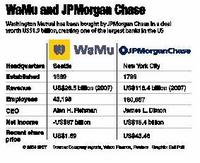
A woman passes a branch of Chase Bank in New York's financial district on Friday, September 26. The Federal Deposit Insurance Corp seized WaMu on Thursday, and then sold the thrift's banking assets to JPMorgan Chase & Co for $1.9 billion. - AP