Gareth Manning, Staff Reporter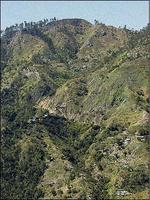
Denuded hills of a section of the the Blue Mountain watershed in eastern Jamaica. - Ian Allen /Staff Photographer
POOR AGRICULTURAL practices, pollution and squatting pose the biggest threats to the island's 26 main watersheds.
"In most of our watersheds, we have caused massive degradation in terms of vegetation loss. Therefore, when it rains, flooding and landslides are extremely common," comments environmental consultant, Eleanor Jones.
Jones and her company, Environmental Solutions Limited, have done extensive work on Jamaica's watersheds and its management over the years. In fact, the company is currently engaged in the development of a national water-sector adaptation strategy to address climate-change impact. The project is being implemented with funding from the World Bank.
worst watersheds
According to Jones, St Thomas watersheds are among the worst in the island. The parish has three main watersheds, one of which is the main supplier of water to the Kingston Metropolitan Region (KMR). But it seems, she notes, that the people who depend on the watersheds most are the very ones destroying them. Although St Thomas has the largest concentration of small farmers in Jamaica, bigger farmers are also a huge problem.
"Our coffee farmers, for instance, in St Andrew and St Thomas, have this idea that you have to clean off the slopes and then put bananas and plantains to shade the coffee plants," argues Jones.
On a recent trek into the hilly interiors of the Morant River watershed, The Sunday Gleaner witnessed what Jones has described: large, grassy parcels of land on hillsides lay bare, stripped of trees, rendering the sheltered valleys and roads below flood-prone. In fact, that happened during the passage of hurricanes Dean and Ivan in 2007 and 2004, respectively. Evidence of scarring is still visible in areas such as Somerset and Mount Lebanus, where many houses lie abandoned due to constant flooding.
"The man dem burn off the hillside dem," says 57-year-old coffee farmer Doriley Brown of Somerset. Though he does not admit to engaging in slashing and burning, he says it is done frequently in the area, especially by younger farmers.
"Everybody want fi go pon the fast lane. Nobody want fi go pon the slow lane because most of dem not working otherwise and making money, apart from the farming," says Brown. According to him, competition from other large farmers and importers makes it difficult for small farmers.
The main crop produced in Somerset is carrot, which is selling for $30 per pound these days.
"You have fi use manpower fi clear the land, so you haffi pay a man $1,000 fi weed it and then you haffi pay fi transport it," says Brown. To avoid some of the costs, many set fire to the land or use weedicides or insecticides to clear it for farming. During the dry season, it becomes particularly dangerous as dry winds and scorching sunlight torch the hillsides.
The lack of potable water also poses a challenge to the farmers. Though they live and work in a watershed, irrigation is next to non-existent. "The lack of irrigation causes some of the farmers to go further up into the hills, where they clear more of the land and damage more of the watershed," explains local environmentalist Terrence Cover.
River Pollution
River pollution is also quite serious in this area, Brown tells The Sunday Gleaner. The main danger, though, is from weedicides and insecticides used by farmers to clear the land and by the fishermen to kill fish. The Morgan River, which flows directly out of the Blue Mountains, is very heavily polluted.
The practice has already taken human lives. One woman and child were lethally poisoned last year as they bathed in the river, and about four others were also poisoned, but not fatally.
Joseph Buchanan, a fisherman in Mount Lebanus, a community a few miles away on the other side of the valley, corroborates this. He says chemicals, like chlorine, are used to kill the fish in the Negro River, which also flows directly from the Blue Mountains.
"One time, you could come to river with a handful of rice, and fish come eat it out of your hand," Buchanan says. That has changed in the last 15 years and the river has lost some species of fish, he says, such as one known to residents as the black nose. He says the police have been called in on a number of occasions, but usually, perpetrators get off with a warning.
"We need some education to let people know what they are doing is wrong cause nuff a dem don't know, as they are young," Buchanan says.
That may be true. A community leader in the Somerset district, Joscelyn Brown says a number of people are illiterate and so, often decline to attend meetings and workshops.
Large-scale farming
But small farmers are not the only troublemakers in the watersheds. Large-scale farmers contribute greatly to their endangerment.
"They have the bigger equipment and so they can clear a lot more land," says Cover, who is president of the St Thomas Environmental Protection Association. He points out brown patches of cleared land on the hillsides of the Blue Mountain.
Government, too, is to blame for deforestation in the mountains. Action taken in the early 1960s to clear hillsides for the planting of pine trees for lumber left slopes bald and vulnerable to slippage.
"Biodiversity issues need to be taken more seriously and we need laws to be enforced," says Cover. He says while many need to be upgraded, such as the Watersheds Protection Act and the Wildlife Protection Act, the laws are not being enforced because those responsible for enforcing them are not aware of their role.
"The Island Special Constabulary is supposed to be enforcing some of these laws and sometimes they don't even know," says Cover.