
Edward Seag Sports has been dominating the news. In athletics, Jamaica has reached the pinnacle of success. In football, the Jamaican ranking internationally is at its lowest ever, and the prospect of continuing in the elimination round to qualify for the 2010 World Cup is no longer promising.
Track has opened the door for Jamaica to the world by the unbelievable exploits of the Jamaican team in Beijing. Tiny Jamaica is now among the world superpowers of athletics in sprint events. What an achievement!
But the prospect for Jamaica's football is at the opposite end of the scale for the national team, the Reggae Boyz.
medals
The table has turned. It was customary for Jamaica to win a small number of medals at the Olympics, mostly silver and bronze, with a single gold, possibly. At Beijing, the team captured six gold medals and five in silver and bronze.
In comparison, the Reggae Boyz are lingering with one point in last position in their World Cup qualifying tournament. Hopefully, since the remaining games are at home, the crowd will inspire them to succeed.
The contrast does not end there. All but two of the successful Olympians were trained by two Jamaican coaches, Stephen Francis and Glen Mills. The performance of their trainees puts these coaches at the top of their professional group worldwide. But their earnings are on the lower levels, based on scales available to Jamaican coaches.
In comparison, the football coach René Simoes, who was recently dismissed because of a losing record in the Word Cup qualifiers, was earning many multiples more than that.
This sharp contrast is telling us that we may have our priorities upside down. In the meantime, Francis, who can do considerably better financially abroad, is being enticed to migrate. Why not? He has not shared equally in the kudos and recognition being given to the Olympic team performance, although he coached most of the successful athletes. It seems that a possible disaster could be in the making because of neglect or oversight.
At the same time, a disaster has already hit the football programme, which is now changing the coach in the midstream. Trinidad, by the way, if I remember correctly, did the same thing in the last World Cup qualifying rounds and beat the odds of a late change of coach to go on to win and qualify for the World Cup.
The best that can be said here is that football does not have the same clear prospect for success as track and field at this time. It is going to be a long climb back up the ladder from the present ranking above 100 to where it was, under 30, when the programme started with the same coach, Simoes, in the late 1990s.
Those of us who knew the Reggae Boyz then and now would admit that, ironically, the first Reggae Boyz team which qualified for the World Cup in France was not as accomplished and skilled as the present team. That team to France had few overseas players. The team to South Africa, which looked good in their first outing in Jamaica, consisted almost entirely of overseas players.
loosing credibility
From all the contradictions, it should be clear that something is radically wrong. It does not appear to be just a problem of who is the coach. The JFF would be wise to adopt a wider view and do some investigations to find out what are the real problems before football loses more credibility and everyone loses more confidence. The problem could be much deeper than we think.
Highly successful track and football programmes are the key to Jamaica establishing a reputation as a prime sporting country for future growth and national development.
It might be surprising to learn that a study done by Dr Vanus James titled, 'The contribution of sports to Jamaica's GDP and employment' in 2005, indicated that the number of persons employed in sports and related activities in Jamaica total some 22,000, which positions sports in the high employment category of the economy.
Following on that, sports is a substantial contributor to the GDP because it draws heavily on indigenous resources, paying out little overseas. Compare this with tourism, which pays out 66 per cent of its earnings for commissions, various services, imports of food and drink, various raw material, capital goods, furniture fixtures and fittings, leaving 33 per cent in Jamaica.
ramification
The ramification of sports throughout the economy is very wide:
Facilities have to be provided requiring investment in structures, fields, courts, pools and gymnasiums.
Athletes have to be cared. This opens the door for medical therapists and specialists, including sports psychologists and nutritionists.
Training requires coaches of different skills for fitness and performance.
Gears for players play a major role in sports sponsorships and creates opportunities for manufacture and branding.
Agents and managers of athletes are essential to success.
Lawyers specialising in law and regulations governing sports and in copyrighting are critical to the orderly performance of sporting activities.
Promotion of sports and athletes require a range of personnel trained in different skills, media writers, cinematographers, publicists, broadcasters, announcers, news correspondents, magazine publishers and image builders.
These professionals need technical training, equipment and studios.
Finally, investment counsellors and bankers are necessary to finance ventures.
This illustrates the extent of the outreach of sports and the linkages to sporting activities which create an industry.
Sports, then, is not merely a pastime, or a hobby, or even just serious competition. It is business, a substantial contributor to the economy.
Jamaica has only touched the edge of the circle which encloses this network. If we are serious about reaping the considerable benefits of sports, much more has to be done to reach the heights of recognition that track athletics has reached, not just by outstanding performances, but by going beyond that to position the performers, the coaches and the countries of origin as brands, which ultimately is what the public will remember after the shouting and cheering are over.
This is the enduring factor of sports which creates benefits long after the event, and even after the life of the performer.
potential earnings
Business in Jamaica is not sufficiently alert to the massive potential earnings for sports or the need to promote its development so as to reap rewards.
Perhaps, if business does not comprehend the value of sporting activities economically, it should at least recognise the potential of sports as a social stabiliser which levels the social playing fields, cuts across borders of colour, race, nationality, gender and age. Everyone cheers winners in sports, no matter their origin. For that moment in time, and as long as the memory lingers, all those who cheer are one family, one people, one race.
That is why the intense bitterness which has covered Iraq with deep hatred, violence and death, prevented the Iraqi football team, with a mix of Muslim sectarian connections, from training in Iraq. They trained across the border in Iran, played their qualifying matches in Iran, but when they won, everyone cheered in Iraq.
productive relationship
A ping-pong competition between an American and Chinese team in China more than three decades ago opened the door for President Richard Nixon of the United States to lay the foundation for the two countries to have a productive relationship after years of post-war hostility.
This is why in the streets of downtown Kingston, where guns used to bark in communities steeped in historic political rivalries, there are now friendships instead of enmities, love instead of war, because of football. And where did this momentous change start? All on a playing field!
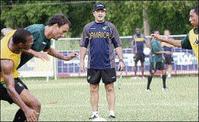
Former technical director René Simoes (centre) looks on as Obrian Woodbine (right), Rudolph Austin (left) and assistant coach Luciano Gama take part in a Reggae Boyz practice session at St George's College earlier this year. - file
Edward Seaga is a former prime minister. He is now a Distinguished Fellow at the UWI. Email: odf@uwimona.edu.jm. Feedback may also be sent to columns@gleanerjm.com.