
Ian Boyne"The house of global finance is on fire and everyone is running for the exits, no sure way to turn them around. What's next? The question itself is ominous, because there are no good answers." William Greider, the Nation magazine.
"We've seen crisis. We've seen recession. But we have not seen the core of the financial system shaken like this," the Wall Street Journal on Thursday quoted one investment banker as saying. The collapse of Lehman Brothers, the US$85 billion rescue of American International Group (AIG), the bailout of investment giants Fannie Mae and Freddie Mac, alongside the forced selling of Merrill Lynch, have sent the financial press in a frenzied competition for appropriately dire superlatives.
The usual passing off of these crises of the market and of capitalism as just cyclical - part of the boom-bust rhythm - is simply not credible in this instance. There is something profoundly different and salutary about this latest financial crisis. And something unique about how the United States Federal Reserve has responded.
Writing in the New York Times on Thursday, Allan Meltzer, a professor of economics at Carnegie-Mellon University, who has written a sweeping history of the Federal Reserve, offers: "This is unique and the Fed has never done something like this," in reference to its takeover of AIG.
He continues: "If you go all the way back to 1921 when farms were failing and Congress was leaning on the Fed to bail them out, the Fed always said 'it's not our business'. It never regarded itself as an all-purpose agency."
Earlier, the Fed also had to bail out another Wall Street giant, Bear Sterns, to the tune of $29 billion under the deal with JP Morgan.
On Thursday, the Fed pumped as much as US$105 billion in short-term loans to US banks, while promising to supply a total of $180 billion to foreign counterparts short on dollars. Other central banks also rallied to help market forces, putting, no doubt, bemused smiles on the faces of critics of the neo-liberal economic dogma which is the current orthodoxy.
In an article in its Thursday edition titled 'Abroad bailout is seen as a free market detour', the New York Times says, "In extending a last-minute $85 billion lifeline to American International Group, Washington has not only turned away from decades of rhetoric about the virtues of the free market and the dangers of government intervention, but it has probably undercut future American efforts to promote such policies abroad."
The New York Times says that "For opponents of free markets in Europe and elsewhere, this is a wonderful opportunity to invoke the American example. They will say that even the standard-bearer of the market economy, the United States, negates its fundamental principles in behaviour."
The free-market, Washington Consensus ideologues have finally been mugged by harsh experience. Perhaps now we can have less ideological and more pragmatic commitment to the market.
conservative
Time magazine writer Justin Fox, in an article dubbing the US "Bailout Nation", says the bailout of Fannie Mae and Freddie Mac "amounts to a stunning return to Government control over the US financial system, incongruously led by a former Wall Street boss (Paulson) working in what is purportedly a conservative Republican administration."
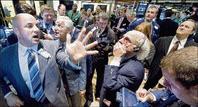
Specialist Henry Becker (left) directs trading at the post that handles AIG on the floor of the New York Stock Exchange on Tuesday, September 16. Stocks extended their decline and bond prices jumped Tuesday, a day after Wall Street's worst session in years, as nervous investors grappled with concerns about insurer American International Group Inc. and awaited the Federal Reserve's decision on interest rates. - ap
And remember that in the Asian financial crisis, a condition of South Korea's receiving a US$20 billion International Monetary Fund (IMF) loan was that it allowed the banks and other financial institutions to crash rather than bail them out. AIG's crash, of course, would be disastrous for the world, as it has links in 130 countries and is a pivotal player in this financialised world. But it still leads us to ask: what if the US had to follow IMF conditionalities and the dogma of the Washington Consensus to which it holds developing countries?
What was very interesting was the fact that on Thursday Wall Street ended a volatile session slightly higher, only after a report emerged that the US government was considering the creation of an entity that would take over the banks' bad debts. This is what some in the progressive movement have been calling for some time "socialism for the bankers". Capitalist governments are only too willing to provide bailouts for the rich and powerful while scorning assistance to the poor and raising all kinds of seemingly sophisticated arguments as to why that assistance would create "distortions in the economy".
But the moral hazard argument is raised when big businesses and large financial institutions run into trouble.
Savings and Loans Crisis
During the 'Savings and Loans Crisis' of the 1980s, the rich were rescued (of course, their collapse would have an effect on the poor) and a Resolution Trust Corporation was established. Wall Street clutched at the news that the Federal Government might be thinking of creating a similar institution in light of the present meltdown.
After so many years of bashing government and the role of the state, even hardened dogmatic free marketers have to cling to state initiatives in the face of market failures.
An impressive group of progressive and liberal economists have been attacking the end-of-the-state dogma which has been a feature of neoliberal, Washington Consensus ideology. People like Dani Rodrik, Joseph Stiglitz, Nancy Birdsall, William Easterly and Ha-Joon Chang have done first-rate scholarly work to show that government intervention in markets is crucial to economic successes and social stability. It takes a crisis like this to jolt the free market ideologues back to reality and from their comatose condition.
When the great Morgan Stanley and Swiss bank UBS have to be scrambling for buyers, then you know we are in a crisis. But for years economists have been warning of the dangers of financial liberalisation and the growing financialisation of the global economy. They warned it was artificial, dangerous and fraught with systemic dangers.
The propaganda against regulation by neoliberal dogmatists fuelled irresponsible, imprudent practices in the financial sector. This is what is at the heart of the subprime crisis in the housing market in the United States, which has reverberated all over the world in this era of globalisation.
role of the state
Financial liberalisation has also weakened the role of the state, to deleterious effect (An excellent paper to read is Jomo Kwame Sundaram's 'Obstacles to Implementing Lessons from the 1997-1998 East Asian Crises' published by the Department of Social and Economic Affairs of the United Nations, as well as Robin Blackburn's 'the Subprime Crisis' in the March-April issue of the New left Review).
After the Great Depression - and this crisis is said to be the worst since then - the US Government tightened banking regulations to protect and stabilise the banking system. An important piece of legislation was the Glass-Steagall act which separated commercial from investment banks and prohibited interstate banking. The act also regulated the activities of commercial banks, including interest rates, and also restricted entry into riskier investments.
But the neoliberal theologians and capitalist interests - in the name of enlightenment - lobbied for that act to be repealed. Momentum picked up under Reagan and, interestingly, the Democrats under Clinton completed the revolution in 1999.
global financial assets
In the US today there is a decline in lending to production and trade and a phenomenal rise in paper transactions. In 1980, net interest income was $56 billion compared to $14 billion for financial instruments. By 2005 that was reversed: Net interest income was $270 billion versus $201 billion for non-interest income.
The global economy is badly skewed in terms of financial instruments versus real production of goods.
In 1980, the ratio of global financial assets to annual world output used to be about equal, but by 2005 it was three times larger. In 2007, global financial assets amounted to US$140 trillion, compared to global gross domestic product of only $48 trillion in 2006. Turnover in foreign exchange markets today is a whopping $3.2 trillion a day, compared to the volume of world trade of just $12 trillion a year.
Global liquidity markets last year were estimated at $607 trillion - 12.5 times global GDP. As senior fellow Michael Mah Hui Lim says in a working paper for the Levy Economics Institute ('Old Wine In a New Bottle: Subprime Mortgage Crisis-Causes and Consequences') "We have arrived at a stage where what happens in the financial markets affects, perhaps dictates, what happens in the real economy. It is the case of the tail wagging the dog." Talk about moral hazard!
The world urgently needs a new global financial architecture. Bretton Woods has collapsed. What reigns now is chaos. Financial globalisation is turning out to be a nightmare, and what that insightful and brilliant international statesman and thinker, Michael Manley, campaigned for in the 1970s is even more urgent today - A New International Economic Order. The philistines who opposed him then and now in their abysmal shallowness, and who talked about only putting the domestic house in order, have been exposed for their folly.
A new study just released by the Council on Foreign Relations' Centre for Geoeconomic Studies, Sovereign Wealth and Sovereign Power (and written by Brad Setser, one of the finest scholars on finance) raises worrying prospects for the United States. Its $750 bullion current account deficit - more than 5.5 per cent of its GDP - makes it vulnerable in this global financial order.
The US subprime crisis, the new study points out, "highlights the risks associated with ignoring latent vulnerabilities. Reducing the United States current reliance on foreign governments to finance its deficit should be an important priority for the next president".
And suddenly the US presidential race is dominated by economic concerns - and Barack Obama has been experiencing a surge in the polls as the crisis shows up precisely what is wrong with the Republican party's minimalist Government dogma. McCain has been trying to hijack Obama's platform of Government-as-facilitator, but it is too late.
One hopes, though, it will not be too late for the international community to realise that something must be done urgently to address the crisis in the global financial architecture, which neoliberalism cannot solve but, indeed, has engendered.
Ian Boyne is a veteran journalist who may be reached at ianboyne1@yahoo.com. Feedback may also be sent to columns@gleanerjm.com.