Michael Reckord, Gleaner Writer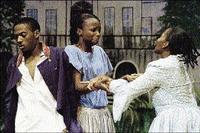
A moment of doubt and apprehension in 'Mansong'.
You shouldn't try to constrain artists with rules. They might last for a while, then some maverick comes along, pushes the envelope to breaking point and is hailed as a genius. The history of art is replete with examples of such persons.
Still, there is a fundamental concept which guides - let's not say rules - all art, that of unity. To be regarded as whole and complete, the genre of a dance will be ballet or modern; a piece of music will be jazz or folk and a painting will be abstract or realistic, for example.
The drama director, too, needs to know what style he is using. Is his play comedy or tragedy or farce or melodrama? He mixes his styles at his peril.
Aston Cooke, one of our most experienced and successful theatre practitioners, mixes his directing styles in the current Jamaica Youth Theatre (JYT) production, Mansong. Under his direction, the play is part realistic, part musical theatre, part farce and part melodrama.
It does not work.
Drama festival
The play, a folk comedy written by Ted Dwyer, was staged at the Philip Sherlock Centre for the Creative Arts over the weekend. It will be taken to a number of schools in the coming weeks and then in November to Guyana, where it will compete in the Caribbean Schools' Drama Festival.
It will probably do well (Jamaica usually takes home several awards from these competitions), for it has many strong elements. But unless Cooke makes some adjustments, he might not get the Best Director award.
The printed programme gives, along with a list of the JYT's annual productions starting in 2004, a quick history of Jack Mansong. He is both "the most-feared runaway slave in Jamaica during the 1700s" and "one of the best-known Jamaican folk heroes of the time". Obviously, the descriptions represent two different points of view.
The 'history' continues: "Jack Mansong was injured in a fight with a Maroon named Quashie, and thus lost two fingers. (Hence the nickname Three-fingered Jack.) Despite his leadership of an unsuccessful rebellion at his home plantation, Jack escaped to the mountains and terrorised the island. Historians say the very mention of Mansong's name drove fear into the hearts of white plantation owners in Jamaica and those in Britain."
This blurb bears the patina of legend rather than fact, but we shouldn't carp since Dwyer made a successful play out of it. Some will remember that it was originally staged as a Little Theatre Movement Pantomime. In this production, it has been stripped of its music, except for a dance choreographed by Danar Royal, which comes early in the play and then closes it.
mysterious
The action begins with an old slave, Dada, excellently played by Joseph Collington, engaged in some expository dialogue with two other slaves, Teena (Petrina Williams) and Tuckey (Lamore Bryan). One of the things we learn is that Teena, for a mysterious reason, is avoiding Quashee (Tayne Robinson), who loves her.
Dada begins telling the Mansong story to a group of slaves and it is the dramatisation of this narrative which partially constitutes the play. The other part is the dramatisation of the story of the engagement of a young lady of the great house, Rosa Chapman (Natalie Reynolds), to a newcomer to the island, Captain Edward Whitehorn (Brian Johnson).
Dwyer very cleverly links the two tales into a suspenseful, humorous play. The story unfolds against a backdrop of a huge Larry Watson painting of a great house and its background hills overlooking sets representing Dada's thatched-roof hut, the great house's living room and Mansong's bush hideout.
The characters, who also include Mansong (Randy McLaren), Mrs Chapman (Kajha Escoffrey), the slave driver Sam Power (Timothy Gordon) and Custos (Fontain Jones), are realistically costumed by Quindell Ferguson and played with energy and understanding. It is in what the director made them understand that the problem lies.
Cooke directed the scenes outside Dada's hut to be played realistically, the scenes in the great house involving Rosa and her mother to be played as farce - with exaggerated gestures and diction - and directed Jack to be portrayed melodramatically, so that his manner is nearly always bombastic. As the action switches from scene to scene, the audience is dragged from one acting style to another and back again.
unsettling
Things really get impossible when one character plays in one style and the other in the scene plays in another. This happens in, for example, a scene with Teena (who is realistic) and Rosa (who plays farce). It was very unsettling.
Which is not to say that the audience, filled the night I saw the show with friends of the cast, did not like the play. There was much laughter and cheering. But in Jamaica we know that audience enjoyment is not directly proportionate to a work's artistic merit - this despite the fact that plays are produced for general audiences, not for critics.
commercial
Ferguson told The Gleaner that the cast came from the better actors of about eight schools which entered the last Secondary Schools' Drama Festival. JYT is performing a good service by providing a bridge between school productions and the commercial theatre.
But the managers of the JYT need to remember that artistic integrity is not a primary objective of the commercial theatre and some actors leave high school for the School of Drama, where integrity is the watchword.
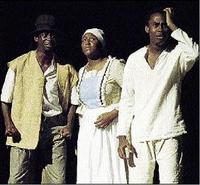
The women bond, while the man looks away. - Peta-Gaye Clachar/Staff Photographer
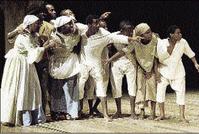
Something hugely significant is afoot in 'Mansong'.