Errol Hewitt, Contributor
Hewitt
"But I have this one charge to make against you: that you have left (abandoned) the love that you had at first"- Revelations 2:4
The recent divisions in the People's National Party (PNP) have held the nation's attention because of the importance of the party's leadership, its effectiveness as an opposition in Parliament, and as an alternative government in waiting.
Whoever emerged as president from yesterday's elections is already on record as being committed to bringing changes to the party. The Portia Simpson Miller faction acknowledged that such change would take account of the 2007 PNP-commissioned Meeks Report.
The Peter Phillips faction accepted the recommendations of the Meeks Report, but stated that the crux of the report called for an expressed vision under-girded by the PNP's initial policies (back to its roots) and culture.
The nation is in a severe long-term crisis and urgently needs serious government in which the two major political parties are committed. Quality leadership and how the PNP is organised and operates are, therefore, critical issues in the nation's interest.
Political decisions
Whoever is elected as the party's president, if serious, needs to read with an open mind the absorbing two-part series in recent issues of The Sunday Gleaner by Claude Clarke, a former minister of trade, on the political decisions taken by the party.
These decisions, in his view, have played a large part in leading the nation into our present social and economic predicament.
Undergirding these two essays is the tremendous importance and responsibility of good government and the disastrous effects of incompetent ones on a nation and its people.
Clarke seems to suggest that a major cause for the accelerated slide of the country's economy was the return of an unprepared PNP to government in 1989.
He points out that while the party had ditched democratic socialism as its governing philosophy, it neither had a clear vision of the nation's future nor any plan for the way forward. Sure, there were individual projects, but these were not linked, or seemingly, part of any overarching plan.
In his view, the decision that catapulted Jamaica on to that slippery downward slope was Michael Manley's surprise announce-ment at a political meeting in 1990 of his government's "liberalisation of the foreign-exchange system".
This seemed like a spur-of-the-moment decision as there had been no discussion and determination within either the Government or the party.
The decision was as contrary to the party's traditional philosophy of assuming the "commanding heights of the economy" as it was to the Jamaica Labour Party's [JLP] practice of a managed economy. To most in the party, the decision defied economic logic and seemed bereft, as Clarke states, of any "appropriate institutional, monetary, fiscal, trade and administrative policy arrangements ahead of its announcement to ensure its smooth introduction and operation".
'thinking-man's party'
At the core of what happened in 1990 was the fact that the leader could be allowed to make such crucial decisions unilaterally about a nation's future - seemingly in the heat and excitement of a political meeting, with adrenaline pumping and the need to further feed the excitement.
But how could the 'thinking-man's party' come to this point? What lessons are there for the PNP of 2008?
Until Michael Manley's second term, the PNP had incorporated a democratic model based on groups within the constituency and fitting into larger groups representing a region and at the national level, the National Executive Council (NEC), beyond which was the annual conference. These ensured the party's feet were firmly planted in the community, allowing for grass-roots community involvement and the pursuit of these interests through to the NEC level, if necessary.
Group participation
The groups were encouraged to make suggestions on national policies which, if accepted at the regional level, could go through the NEC to be adopted by the annual conference.
With increased participation, the groups became vibrant, adding new vigour and ideas to the party. This, in turn, attracted new members, particularly from among the youth.
As enthusiasm grew, so did the groups' interest in the performance of the party's ministers in government and the scope and direction of their ministries. There was, therefore, greater interactivity between the ministers and the governing party.
This concept of the group as integral to the operation and development of the party was a basic tenet, but took on new life with the departure of the four H's [the Hills and Hart] from the party, with their strong influence on the trade-union movement and fears that the party would have lost its popular base going into national elections.
The party's dramatic success was seen as not only due to the formation of the National Workers' Union, but in large part, directly related to the emphasis of the group concept and increased participation of the grass roots. The success of the group concept was seen also in the policies it influenced and the heightened responsiveness of the party.
The concept proved itself also to be an effective tool in educating the grass-roots level about the party's philosophy, as well as about national and international issues.
There was then [contrary to the party's view in 2008] no mystery as to the credible existence of a group at the community level, so keen was the participation and its effectiveness within the community.
In fact, so integral was the working of the group to the party's success, in terms of both national governance and electoral potential, that nurturing through the group was seen as an essential prerequisite for new constituency candidates - no parachuting of favoured candidates into constituencies.
WHAT WENT WRONG?
What could have gone so wrong in a party, which developed a reputation for being a 'thinking-man's party' with a strong middle class [acknowledged to be the rudder of all democratic societies] at its core?
In fact, Norman Manley, with his established intellectual brilliance, and, aware of his own perceived arrogance, had ensured a Cabinet and inner circle which could both debate and interchange ideas with him - Nethersole, Arnett, M.G. Smith, etc.
Manley's home at Drumblair became the sanctuary for the discussion of new ideas relevant to both the arts and socio-economic development.
This, in turn, became the tradition of the party, i.e., a willingness to explore ideas and their socio-economic developmental potential. In truth, the PNP had become not just a political party, but a movement.
Michael Manley's first term was built on this concept and added even greater emphasis on the group as the means of community development and the entrenching of grass-roots support in the electoral process.
In fact, the party's defeat seems to have had more to do with the middle-class's alarm at the hysterical tone and pace of socio-economic change than with the issues of change. Proof of this is that many are currently being introduced by the current JLP government.
His second term was markedly different from the first. The ditching of democratic socialism was not replaced by any overarching philosophy and the isolation of the left-leaning members removed an alternative point of view, as well as their considerable influence over the groups.
As Clarke puts it, "In the absence of a clear philosophy to guide the development of policy in those first years, the decisions of government seemed to drift without direction or rationale."
It is within this context of disarray that the unopposed decision to liberalise the foreign-exchange system was taken.
Michael Manley's exit from the party's leadership led to the accelerated decline of the groups' influence within the party.
His successor had a more mediatory style of leadership and relied more on his advisers and the bureaucracy of the administration.
As such, decisions were increasingly taken at the top with fewer requirements for and reliance on the party's input.
without a cause
With the decline of the groups' influence on the party, they steadily lost many of their functions, such as educating the membership and representing the community's needs. Increasingly, their only real function was as part of the party's election machinery.
Without the party's traditional strong and visionary leadership, which blended so well with its middle-class core, and the enhanced participation of the membership, its main focus was remaining in office.
Without a cause, it no longer generated the passion of a movement. With the exception of its election functioning, the de facto disconnection of the groups from the leadership has robbed the party of its dynamism and passion for new ideas. It has also made its grass roots more latent and less vibrant.
Our country needs an active and able opposition party; good governance requires an organised and potent [not combative] opposition.
The challenge to the new leader must be, first:
To unify the party with the realisation that it makes sense that no one be left behind;
Re-establish its traditional middle-class values and uproot the source of every whiff of corruption.
Reconnect its base through functioning groups readily recognised throughout the party.
But, most important, is a vision to aspire to an identified and unifying cause.
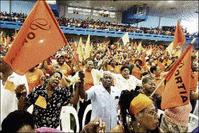
Delegates in a celebratory mood at last year's PNP 69th annual conference at the National Arena, St Andrew. - File
Claude Clarke ... analysed where the party went wrong.
Errol Hewitt is an information and communications technology planning consultant with the United Nations and the Commonwealth Secretariat. Feedback may be sent to estahewitt@yahoo.com or columns@gleanerjm.com.