Paul Messam, Gleaner Writer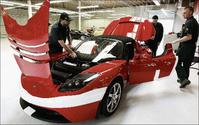
Tesla workers assemble a Tesla Roadster at their showroom in Menlo Park, California, September 16. Tesla expects final approval of a deal with the city of San Jose, Calif., for a plant to build the Model S, an all-electric sedan. Tesla's cars run on a massive lithium-ion battery pack that can be recharged by plugging an adapter cord into a wall socket. - AP
IT IS a known fact that one's driving habits have an enormous impact on fuel consumption. With the help of Kurt Harding, an experienced St Andrew-based auto mechanic, Automotives offer the following tips that can help you save at the pumps.
Do not tailgate
It is both dangerous and uneconomical. From a fuel consumption standpoint, a 'tailgater' is alternately hitting the brake pedal and accelerator pedal. This wastes fuel.
Maintain a steady speed, within limits
Gas consumption increases with speed. When driving, for example, at a steady 50 mph, approximately half of the fuel used by a motor car is used to push air out of the way.
Avoid jack rabbit starts
Fast starts cut fuel economy. Slow starts, getting into high gear as quickly as possible, and moderate, consistent driving will significantly improve your fuel economy record.
Practise stop and go passing
To pass another vehicle, it is best to avoid running up its back, slamming on the brakes and hitting the accelerator pedal to get around. Instead, start your pass well to the rear, so you can swing out smoothly and execute the pass without braking and then hitting the accelerator pedal.
Do not idle excessively
An engine that idles for three minutes uses as much gas as a car that is driven half mile at 30 mph.
Try not to brake unnecessarily
If you can keep rolling, do not stop. This means trying to time traffic lights. If a light in the distance is red, coast up and brake slowly. If the light turns green before your car reaches the intersection, apply steady pressure on the gas pedal. Stay off the brake pedal if you can.
Ensure tyres are properly inflated
Keeping tyres inflated to the correct air pressure and having front wheels properly aligned reduce friction that puts drag on the car. The engine must work harder with improper inflation, consuming more gas to overcome drag.