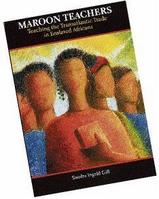
Title: Maroon Teachers: Teaching the Transatlantic Trade in Enslaved Africans
Author: Sandra Ingrid Gift
Publisher: Ian Randle Publishers
Reviewer: Barbara Nelson
"I WAS especially surprised and astonished to find out that the first person to perform an open heart surgery was a black person, and that the person who made the stop lights was also black. These are great achievements and there are also many more. Although black persons had a rough and horrible past, they have made many contributions and I am very proud of my African heritage and their creativity."
This was how a Barbadian student expressed surprise, astonishment and pride when she discovered the contributions of Africans. The student was preparing to take part in the youth forum organised by the UNESCO Associated Schools Transatlantic Slave Trade Education Project.
A teacher in Jamaica who commented on the project spoke of "efforts to look at the positive aspects of the legacies of the trade". While she acknowledged the oppression of the Africans and their descendants, she and her colleagues also looked at the positive aspects of what the enslaved Africans brought and what still exists.
Sandra Gift, author of Maroon Teachers, is senior programme officer in the quality assurance unit, Office of the Board for Undergraduate Studies at the University of the West Indies, St Augustine campus, in Trinidad and Tobago. She has a PhD in education and more than 20 years experience in education in the Caribbean and internationally.
Slave Trade
Dr Gift has served as regional coordinator in the Caribbean and the Americas for the UNESCO Associated Transatlantic Slave Trade Education Project, the educational arm of UNESCO's Slave Route Project.
In this 197-page book, which is based on her 2005 doctoral dissertation, she uses the findings of a qualitative multi-site case study on teaching the Transatlantic Trade in Enslaved Africans (TTEA) in selected countries in the Caribbean and the Americas, Africa and Europe to offer teachers and other readers multiple understandings of this subject.
Dr Gift feels that several secondary school teachers who participated in the project had to discover creative ways to overcome the constraints of the official curriculum, to allow their students to benefit meaningfully from learning about the history of the TTEA. "They are, therefore, in the eyes of this author, 21st century 'maroon teachers'," she writes.
In her opinion, these 'maroon teachers', and others like them, will assist us as we try to learn the lessons that must be applied "if we are to succeed in the delivery of quality education on the subject of the TTEA".
The book has eight chapters. Chapter one gives a historical overview of the TTEA and its legacies. Chapter two: Background and Conceptual Framework; chapter three: Issues and Challenges; chapter four: Teachers' Presentation of Content Knowledge; chapter five: Teachers' Organisation of Content Knowledge; chapter six: Emotional Dimensions; chapter seven: Educational Significance; chapter eight: Conclusion.
research
Dr Gift notes that the work she did from 1998-2001 as regional coordinator for the UNESCO Associated Schools Project Network Transatlantic Slave Trade Education Project in the Caribbean and the Americas helped her to undertake the research for the book.
Teachers, administrators and students in the geographic regions of the Americas/Caribbean (Barbados, Brazil Dominican Republic, Jamaica, Trinidad and Tobago) and the USA were interviewed for the project, as well as in Africa (Benin, Senegal, the Gambia) and Europe (England, Denmark).
The teachers who were interviewed taught history, social studies, African studies, sociology, special education and library studies. They all had between five and 30 years of teaching experience, and many had higher education training, in some cases master's degrees.
emotional subject
Teachers in all the regions said the TTEA is an emotional subject, and they were attuned to the emotional responses of their students.
The responses and questions posed by the students are many and varied. For example, a teacher in Barbados explained that her students were "confounded" by the fact that although the Africans outnumbered the Europeans both in Africa and the Caribbean, "they did not rise up and take over and resist this situation".
Another teacher in Benin, however, said that it is now compulsory to teach students the rebellions organised by the enslaved, to demonstrate to students that, among the enslaved, there were those who did not accept their fate. Rather, they fled to the bushes where they organised rebellions. This form of resistance, marronage, was developed in the Caribbean and America.


















