John Myers Jr, Senior Reporter
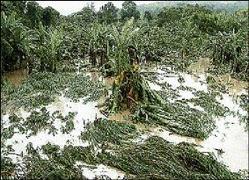
A section of the St Mary Banana Estate, swamped by high waters from torrential rains associated with Tropical Storm Gustav. - File
The government will have to write off most - and most likely all - of the nearly $300 million in insurance support it had to provide to banana farmers last year to coax them back into production after Hurricane Dean.
But with uncertainty still hanging over the export side of the industry in the wake of another devastation by a tropical storm three weeks ago, no one - or no one who has been available for comment - can say with certainty what will happen to the debt.
"That matter (of the loan obligations) has not arisen as far as I know," Donovan Stanberry, the permanent secretary in the agriculture ministry told Wednesday Business. "That is a matter that DBJ (Development Bank of Jamaica) and BECO (Banana Exporting Company) will deal with, and anything further will go to the Cabinet."
Write-off clause
When Dean slammed into Jamaica last august leaving a trail of destruction across the island, fragile banana plantations, including 1,500 acres of farms owned by Jamaica Producers Group in eastern Jamaica, were severely damaged.
Having suffered a string of similar events in recent years, JP, which grows 90 per cent of Jamaica's export bananas and controls up to a third of the UK banana market, was contemplating whether it should resume produc-tion here. The company has plantations in central America.
The government's carrot to get JP to replant its farms and encourage others to follow suit, was to offer, via DBJ, a US$4 million (J$284 million) loan to banana exporters to cover insurance premiums and rehabilitate fields. BECO under-wrote the loan, most of which would have gone to Jamaica Producers.

Dr Marshall hall
However, a critical part of the condition of the agreement was that farmers would not have to repay - essentially the loan would be written off - should the industry be impacted by another natural disaster and more than 50 per cent of acreage was damaged.
Gustav, on the face of it, would have been such an event, although no one has said for certain that the write-off clause has been triggered.
"The principle is that for farmers that made that investment if there was a subsequent disaster such as Tropical Storm Gustav, some relief would be provided by BECO and that would in turn flow through their relationship with DBJ," explained Jeffrey Hall, the managing director of Jamaica Producers Group.
Hall said he has received communication on the issue from BECO, but declined to disclose the content of the letter.
Last week, the office of BECO's executive director, Vincent Evans referred Wednesday Business to the company's chairman, Dr Marshall Hall, for comment.But yesterday, Hall's office referred this newspaper back to Evans, who was not immediately available.
Hall is himself a former CEO of Producers Group and has had to grapple with the issue of the future of banana production in Jamaica, in the face of diminishing preferences in Europe and the impact of storms.
For instance, Dean and Gustav apart, in 2004 Hurricane Ivan wiped out the industry. Sixty per cent of that which was resuscitated was again destroyed by Hurricanes Emily and Dennis in 2005.
Hall's son and successor at JP, Jeffrey Hall, is grappling with the same issue. A week ago, the younger Hall said JP would arrive at a decision within the next month whether it would continue to grow bananas here for export or concentrate on producing the fruit only for its snack lines.
Banana is one of Jamaica's largest export crops, with earnings reaching US$20 million in 2006 when the country exported approximately 30,000 tonnes to Europe under a preferential trade arrangement with the bloc.
john.myers@gleanerjm.com