Sabrina Gordon, Business Reporter

Minister of Finance Audley Shaw browse through the 2008/2009 budget estimates at his Heroes Circle office on March 26.
Jamaica's finance Minister Audley Shaw remained confident yesterday in his ability to raise more cash on the international financial markets, despite a worsening global credit crunch in the face of a deepening crisis in America's banking system.
But Shaw, like other analysts here, conceded that whenever he returns to the market, Jamaica is likely to be asked for a premium on the eight per cent coupon rate that Jamaica paid for US$350 million it raised earlier this year.
"....The potential impact will be the tightening up of the international capital market resulting in an upward movement in interest rates, which will make borrowing more expensive," the minister told Wednesday Business.
But should borrowing become too expensive, though, analysts say that Jamaica could fall back on the over US$2.28 billion in net reserves that is piled up at the Central Bank.
"The NIR can be called upon to provide some funds ... until markets settle, hopefully next year," said financial analyst, John Jackson.
Jackson's is an argument that mirrors the sentiment of the Central Bank, as articulated by its governor Derick Latibeaudiere, when he briefed journalists recently. Latibeaudiere was unavailable for comment yesterday.
The government needs another US$250 million or so to round out its projected US$600 million external borrowing programme for this fiscal year and was expected to head to the markets towards year end for the cash. That would be in time to meet the rollover of a US$300-million bond that matures towards the end of the current fiscal year next April.
But a market with ebbing confidence turned decidedly sour last weekend, with the meltdown of some of the most venerable names in American investment banking, causing Wall Street to run for cover.
First, the 158-year-old Lehman Brothers, burdened with over US$60 billion in toxic subprime mortgage instruments, filed for Chapter 11 bankruptcy and is attempting to sell some of its assets to Britain's Barclay's PLC.
At the same time, Merrill Lynch, having over the past year written down its value by $40 billion because of the subprime crisis, sold itself to Bank of America and the insurers, AIG, America's largest, told the Federal Reserves, it needs $40 billion in liquidity support.
Seeking capital
Washington Mutual, America's largest savings and loans bank, is also in trouble and seeking capital.
All this happened only weeks after the US government effectively nationalised Freddie Mac and Fannie Mae, the biggest underwriters of mortgage, in an effort to shore them up. Between them, Freddie and Fannie support around $5.4 trillion in mortgages, or about half of all mortgages outstanding in the United States. Earlier in the year, another troubled investment bank, Bear Sterns, was bought at a knockdown price by JPMorgan in a deal in which the Feds provided risk support to the buyer.
America's banking troubles have reverberated around the world, knocking values off banks and dragging down international bourses.
Shaw, however, was not overwhelmed by the turmoil, saying it was still possible for Jamaica to snag the cash it needs to close out its fiscal borrowings.
"We don't have to use the traditional bond issue," Shaw said. "There is private placement ... and we have always been looking at various options."
Liquidity on the market

Research Manager at Mayberry Investments Limited, Rex Shettlewood.
"The international capital market is only one source, and there is still a lot of liquidity on the market, even though private institutions will now be more cautious in their approach," he said.
Shaw's remark appeared to hint at the possibility of the Government tapping the domestic market for foreign exchange, which analysts suggested must be a strategy concentrating the minds of technocrats at the finance ministry. The downside here is the impact that this would have on interest rates, which have bumped up in recent months.
"The Government of Jamaica is more likely to seek to raise funds on the local market, giving further impetus for interest rates to increase further in the medium term," said Rex Shettlewood, research manager at the Kingston brokerage house, Mayberry Investment Ltd.
"The growth in remittances will likely be tamed or reduced as unemployment numbers continue to rise in the USA," he said.
Jamaicans send home around US$2 billion a year, and last month Latibeaudiere said that remittances was growing at an annualised rate of 10 per cent.
Shaw did not expect any immediate negative impact from the financial sector fallout on remittances.
Direct impact
"Persons who send remittances are not normally typical employees of companies like Lehman Brothers, so we won't necessary see a direct impact on remittances," he said.
Analysts warned, however, of a likely longer term impact if America's dire banking environment further undermines US economic confidence and triggers a deep recession.
Shaw made clear, though, that the central bank and his own ministry was keeping a close eye on global developments and had been given "specific directives to carry out a detail assessment of any likely impact" from the developments.
sabrina.gordon@gleanerjm.com.
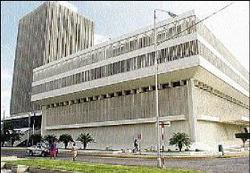
The Bank of Jamaica building, Nethersole Place in Kingston. - File