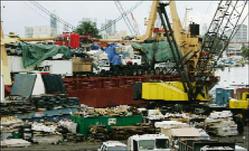
Goods are loaded on this ship on the Miami River in Miami, Florida. The ship left port earlier this month en route to Haiti which is suffering from worsening hunger, soaring food prices and a lack of arable land in the deforested island nation. - AP
MIAMI (AP):
Nadia Renaud began shipping bags of rice, beans and other foodstuff last spring to struggling relatives in Haiti, helping her brother ease the worries of providing for a sick mother who needs constant care.
At first the shipments were a welcome addition for her loved ones in the Western Hemisphere's poorest country. Now they've become the family's lifeline amid worsening hunger, soaring food prices and a lack of arable land in the deforested island nation.
Renaud's brother and sister-in-law eke out livings as market vendors in Haiti's northwest coastal town of Port-de-Paix. But as food has become too expensive and too scarce, the couple now cannot afford many basic staples.
"Everything there is so expensive. They say, 'Even if you are only sending something small, send it. Anything you have, send it, because we cannot afford it,"' said Renaud, 34, who oversees exports to Haiti for Trujillo & Sons Inc., a food distributor.
Sending food
Renaud is among Haitians living in Miami and other US cities who have been sending food regularly to their families in the Caribbean nation, where six Haitians and a UN peacekeeper died during April food riots.
Surveying a 25-pound bag of rice, beans, cooking oil, sugar and cases of bottled juice and ramen noodles stacked on a shipping pallet this month, Renaud lamented the fact that she can only send a shipment every few weeks.
Food transfers parallel cash remittances to Haiti and a handful of other countries, including Cuba and Guyana, where commodities are often expensive and hard to find. Companies that deliver the food into Haiti say orders spiked after the riots.
Because some people purchase and ship the goods themselves, instead of working through a transfer service, there is no reliable estimate on the amount sent through such shipments, known as barrel remittances, said Robert Meins, a remittance specialist at the Inter-American Development Bank.
Remittances
Still, about US$1.83 billion in remittances were sent to Haiti last year, amounting to about 35 per cent of the country's gross domestic product, according to the International Development Bank. The average sender remitted US$150, 10 times a year, to cover daily expenses such as food, housing, utilities, clothing and medicine.
Such cash transfers aren't buying what they once did in Haiti, where most of the nation's 8.7 million residents live on less than US$2 a day. Gas recently topped US$6 a gallon (3.8 litres); food prices are up more than 40 per cent.
Hunger remains rampant, and one in five Haitian children is chronically undernourished, according to the UN's Food and Agriculture Organization.
Some poor Haitians even resort to eating a mix of yellow dirt and vegetable shortening to ward off hunger, and some remote farmers consume the very seeds needed to grow future crops.
The April riots led the US government and UN World Food Programme to pledge a total of US$117 million in food and agricultural aid. But by early July, less than two per cent had been distributed, according to a US Agency for International Develop-ment report.
Food shipments from relatives abroad help fill the gap.
Beatrice Bonenfant, a 37-year-old health administrator from Plantation, regularly sent money for more than a decade to her father, aunt and cousins in the Haitian capital, Port-au-Prince. Two years ago, her relatives asked her to begin sending food instead as rising prices began putting many food items beyond reach. They also worried about neighborhood robberies that made it risky to carry too much cash.
Bonenfant now has rice, cooking oil and tomato paste delivered each month to her relatives' home.
"It's safer, that's what they told me," Bonenfant said.
There are various ways to get the food to Haiti.
Caribbean Airmail Inc., one Miami-based agency, provides customers with a list of basic cooking staples, including rice, beans, vegetable oil and cornmeal, and can ship the food directly to families throughout Haiti.
In a rundown hill district above Port-au-Prince, 29-year-old Yolande Coriolan recently told The Associated Press she and her 48-year-old mother depend on the food and money sent by her boyfriend, a 31-year-old electrician in Miami.
Tutoring students
"Sometimes all we have is the food that he sends, until I get paid for my job and I can buy the things that I need," said Coriolan, who makes US$200 a month tutoring students to read and write Haitian Creole. She said it now costs twice that to buy enough food each month.
"The way things are going, thank God I have him," said Coriolan, who receives oil, rice, beans and other staples through Caribbean Airmail Inc.
Orders through the Miami office of Unitransfer, which delivers items such as rice, flour, milk and spaghetti throughout Haiti, increased 22 per cent in the first half of the year, said Jean-Marc Piquion, vice president of sales and marketing.
But Haitians in the US also have had to cope with rising prices, limiting what they can ship. Many Haitians who once bought supplies stopped when shipping costs tripled and the price of a bag of rice rose from US$22 in January to US$51 this month, Renaud said.