Delano Franklyn, Contributor
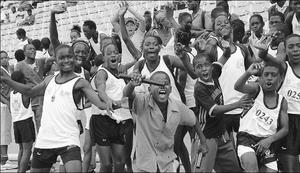
Kingston's victorious team celebrates after winning the JTA/Blue Cross National Primary and Junior High Athletics championships at the National Stadium on May 17. - photo by Ian Allen/Staff Photographer
Having watched Usain Bolt set a new 100-metre and 200-metre world record for men, after phenomenal and dumbfounding sprinting, Shelly-Ann Fraser, Sherone Simpson and Kerron Stewart who finished, first, second and second in the women's 100-metre final, leaving the trio of girls from the USA wondering what hit them, Melaine Walker's smashing performance over the 400 metres for women hurdles, and Veronica Campbell-Brown repeat performance in the 200 metres for women, a friend of mine called me from South Africa to ask, "Why are Jamaican athletes able to run so fast?"
This question is not new; it has been asked time and time again, and increasingly so over the last decade, by persons from all over the world. While no scientific study - which ought to be done - has been undertaken to determine the real reason or reasons why our athletes are able to dominate the sprints on the international circuit, there are a few factors which can be reasonably advanced in our search for answers.
CHAMPS
First, the annually held Boys' and Girls' Championships, popularly called 'Champs', has developed into the most prestigious high school meet in the world. Often, the times recorded by athletes at Champs can be compared with times clocked by other athletes at major international athletic meets.
Champs has been the training ground for most of the Jamaican outstanding athletes who have graced the world athletic stage. Think of some of the greats and you will see the connection between Champs and the renowned performances at the international level.
Arthur Wint of Calabar was dominant in all three classes at Champs, and became the Olympics champion in the 400 yards in 1948. Herb McKenley also represented Calabar at Champs. Dennis Johnson, also of Calabar High School and a product of Champs, became a triple world record holder for the 100 yards in 1961.
Lennox Miller represented Kingston College at Champs. Donald Quarrie represented Camperdown at Champs and went on to become Olympics 200-metre champion in 1976. Velma Charlton of St Andrew High, Rosie Allwood of Titchfield High, Andrea Bruce of Excelsior High and Jackie Pusey of St Mary High all benefited from participation at Champs. So, too, Bert Cameron of St Jago High School, Merlene Ottey of Vere Technical, Juliet Cuthbert of Morant Bay High School, Grace Jackson of Queen's High School, Deon Hemmings represented both York Castle and Vere Technical High at Champs, and Juliet Campbell of St Jago High School.
All members of the current Jamaica squad at the Olympics in China are products of Boys' and Girls' Champs.
As a result of Champs, and the Bishop Gibson relays which started in 1973, our athletes are accustomed to running before spectator crowds of 20,000 to 25,000 from an early age.
Champs is the climax of the numerous athletic meets held throughout the country, on all types of surfaces and in varying circumstances. By the time an athlete reaches Champs he or she would have already been familiar with the cut and trust of years of competition and rivalry developed among the schools. Linked to this tradition of Champs are the legions of old boys and old girls who would go the extra mile on behalf of their alma mater, to ensure that their schools' representatives are in peak condition.
The off-track rivalry among the schools also help to drive the process of preparing athletes to perform at their best. Champs is made possible by the numerous track officials, some of whom can be compared with the best in the world, and by hundreds of volunteers who give of their service without asking for anything in return.
COACHES, SUPPORT STAFF AND MVP
Second, the coaches and their support staff. I well remember the criticisms which were heaped on the Michael Manley-led government of the 1970s, when Cuba decided to construct what is now the G.C. Foster College of Physical Education and Sport in Jamaica. This institution has produced hundreds of coaches who are now giving invaluable service through-out the school system. These coaches have been able to add to what their colleagues - some of whom had pursued courses in physical education at the other tertiary institutions, in particular the teachers' colleges - have been doing over the years.
The establishment of the Maximising Velocity and Power (MVP) Club at the University of Technology (UTech) and other clubs is another positive development in Jamaica's track and field history. Talented athletes who hitherto would have gone abroad for further training are now being developed to their full potential, right here in Jamaica. Asafa Powell, Usain Bolt, Shelly-Ann Fraser, Sherone Simpson, Melaine Walker, Michael Frater, Shericka Williams, among others, are all home-grown talent.
With the performance of our athletes at the Olympics, our coaches and their clubs are going to be in greater demand both locally and internationally. We must do everything as a country to ensure that the necessary support is given to the coaches and their clubs in order to further enhance their skills and knowledge of the sport.
ASSERTIVENESS OF JAMAICANS
Third, the assertiveness of Jamaicans. Jamaicans - young or old - do not easily take no for an answer. We are not fazed by a challenge. We do not back down - irrespective of the weight, height, strength or looks of the opponent. We should all remember when Sherone Simpson ran down Marion Jones on the back stretch in the 4x100 metres women's final at the 2004 Olympics. Jones, drugs or no drugs, height or no height, speed or no speed, did not intimidate Sherone. With the Jamaican never-say-die attitude deeply embedded in her, Sherone closed in on Jones so quickly that Jones failed to hand over the baton to her teammate.
This drive to be at the front of all things manifests itself at all levels, particularly when Jamaicans are abroad or on the international stage. I remember visiting a particular company in the United States in 2005. They had 550 employees, only two being Jamaicans. In a discussion with the general manager of the company, himself an American, he told me that there were only two Jamaicans were on staff - "However," he said, "you would never believe it, as they are the most vocal, and they are not afraid to tell you where they are from."
THE DESIRE TO DO WELL
Fourth, the desire to do well. The vast majority of our youth, despite what others may think, would like to do well. Many are from poor and humble homes, not all are necessarily academically gifted, but do have an ambition to move up the social ladder. Many yearn for the opportunity to access a scholarship to further their education and at the same time continue with their athletic training programme.
Recognising that sports is a way out, they put themselves through difficult and testing physical routines in order to come out on top. The training that an athlete goes through is not easy. It requires discipline, sacrifice, dedication, hard work and a deep love for the sport. The combination of assertiveness, rigorous training and the talent for sprinting, as manifested in our athletes' natural speed, is an inborn formula for leading from the front.
INFLUENCE OF PAST ATHLETES
Fifth, the influence of Jamaica's early pioneers of track and field on upcoming athletes. The heroic performances of persons such as Arthur Wint, Herb McKenley, George Rhoden, Leslie Laing, George Kerr, Cynthia Thompson, Una Morris, Keith Gardner; thereafter, the exploits of athletes such as Donald Quarrie, Marilyn Neufville, Audrey Reid, Michael Fray, Lincoln Belcher; then Sandi Richards, Gregory Haughton, Beverly McDonald, Raymond Stewart and Winthrop Graham, have made a significant impact on the lives of our current crop of athletes. These are just some names that come readily to mind.
THE USE OF DRUGS
Sixth, the desire to rid the sport of those who would wish to gain an unfair advantage by being on drugs. I shudder to think how many of our past athletes have been deprived of a medal at the Olympics by athletes who seemed, from their physical appearance and sometimes phenomenal world records, to be greatly enhanced by things magical.
Merlene Ottey must be wondering why, with all her hard work, loyalty to the sprints and consistency of effort, she was not able to gain that coveted Olympic gold medal. So, too, Juliet Cuthbert and Grace Jackson Small must have asked themselves many times: what if we had a level playing field, would I have got only a silver medal at the Olympics?
FOOD AND GENETIC MAKE-UP
Seventh, what we eat and our genetic make-up. This may be a reason but it is born of mere speculation. Extensive research has to be undertaken in this area. Recently, a caller to a popular call-in radio programme argued that it is as a result of the yam, green banana, dumpling, oxtail and cow foot (and the list goes on) that we eat, that our athletes are so good. Others argue that our natural speed, rhythm, creativity, ingenuity, flair and 'in-your-face' kind of attitude are all a reflection of our genetic make-up. This may be so, but conjecture must not be allowed to override scientific investigation and analysis.
SUPPORT OF JAMAICANS LIVING ABROAD
Eighth, the support of Jamaicans living abroad. There are over 2.6 million Jamaicans living outside of Jamaica - the same size as our domestic population. These Jamaicans, whether in the USA, England, Canada or wherever, have been able to stamp the Jamaican way of life wherever they go.
They play reggae music, cook all types of Jamaican delicacies, wear either the black, green and gold, or the red, green and gold wherever they are, and are prepared to tell all and sundry that they run things. They follow our Jamaican sportsmen and sportswomen wherever they perform. When Usain Bolt broke the world 100m record the first time by running 9.72, he said that, among other things, he was motivated by the number of Jamaicans and Jamaican colours in the stadium.
This kind of support from the Jamaican audience, whether in Jamaica or outside of Jamaica, has gone a long way in helping our athletes to feel loved and appreciated whenever they are on the track.
delanofranklyn@cwjamaica.com.