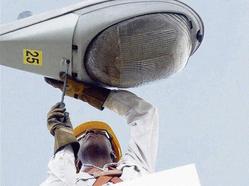
A Jamaica Public Service (JPS) maintenance crew member repairing a street light on Hope Road, Kingston in this Gleaner photo of March 2007. - File
Jamaica Public Service Company (JPS) delivered less electricity to Jamaican homes in the second calendar quarter ending June, but spent nearly twice as much to power the island as it did a year ago, its latest earnings report shows.
The Planning Institute of Jamaica on Tuesday reported that JPS production was down 1.9 per cent in the quarter, ad 1.6 per cent since the start of the year, and that its customers also consumed less electricity as their bills climbed, largely on the back of the expanding fuel charge that represents more than two-thirds of the average customer's bill.
"There was reduced electricity generation by both JPSCo and non-JPSCo sources," said PIOJ boss Dr Wesley Hughes as he briefed reporters on the economy's quarterly performance. "There was reduced demand from three of the six consumer groups."
That same day, JPS released its six-month financials, which gave a more precise reading of how costly an item fuel has become.
The Japanese owned company, so far this year, has spent about $4 billion per month to buy fuel used in the generation of electricity, racking up a total fuel bill of $23.55 billion in six months ending June. More than half or $13 billion was spent in the latter three months.
In line with its licence, the monopoly power provider would have recovered those monies from its customers.
And the effect of fuel at the level of the household was just as stark. Bills of one JPS subscriber, who utilises energy saving devices and techniques, shows that in May 2007, on 187 kWh of power consumed, the Kingston customer's bill amounted to $3,008, with the fuel component taking up 53 per cent at $1,596.
A year later, in July, on 189 kWh consumed by the single mother and her one child, her bill was $5,241, and this time the fuel component was 70 per cent of the bill at $3,659.
Indeed PIOJ reports that in the April to June period, ' housing, utilities and fuel' was one of the biggest drivers of inflation, pushing up prices by 10.2 per cent, and apparently forcing Jamaicans to conserve.
The PIOJ also reports that electricity sales continued to trend down in July, falling off 1.6 per cent to 270.3 million kWh, while generation was down by 2.4 per cent to 366.1 kWh.
The planning agency, however, is projecting that for the September quarter, the electricity and water sector will recover ground.
The power company's revenues have shot up as a result of the bigger bills. Its turnover in six months was $35.4 billion, 68 per cent of which went back into the purchase of fuel.
A year ago, JPS' fuel bill was averaging $2.8 billion per month - $13.9 billion in six months - and consumed 56 per cent of revenues.
Essentially, the power company's gross margins have been substantially eroded in a year because of the explosion in its top expense.
In the period - while world high was setting records to reach US$148 per barrel - JPS' fuel bill rose by almost $10 billion or 69 per cent relative to June 2007; while its revenues only moved up by 43 per cent.
The power company also had bigger operating expenses in the period. Its maintenance bill, for example, shot up by more than $400 million to $2.87 billion, likely as a result of emergency repairs to fix a fault at Duhaney Park that plunged the island into darkness in early January and sparked an enquiry into the company's maintenance programme.
The Office of Utilities Regulation this month released the Winston Hay-led panel report, which reaffirmed preliminary findings that the problem resulted from improper maintenance and monitoring, but said JPS was already taking the recommended remedial action to fix the faults identified.
"The cause of the initiating fault was due to inadequate maintenance of the Duhaney-Tredegar 138 kV transmission line," Hay's team concluded.
"The cause of the widespread shut down following the initiating fault was the non-operation of the primary and backup breaker failure protections at Tredegar substation."
The report also noted that it was the third time in 18 months that the JPS system was experiencing an islandwide outage.
Over the January to June period, JPS' recurrent spending topped $5.2 billion, up 15 per cent year on year, but the company still managed to eke gains of five per cent on operating profit which rose to $3.8 billion.
Its bottomline, however, thinned considerably after depreciation charges as well as a hefty payout of $1.3 billion to service debts that have reached $15 billion.
Net profit $184 million or $1.68 per share is down 38 per cent from $296 million of $2.71 per share.
The April to June quarter was a bad period for the company, resulting in pretax losses of $167 million and net loss of $123 million after tax credits.
JPS is an 80 per cent subsidiary of Maru Energy JPSCO Limited, a company incorporated in Barbados, and the vehicle used by Japan's Marubeni Corporation to hold its largest Caribbean asset.
Marubeni bought the company last July in a deal worth about US$800 million, inclusive of the company's debts, but has since said that JPS' performance has been disappointing - though it would not confirm whether Jamaica was among foreign operations for which it was seeking equity partners to share the risk.
JPS is now valued at a net $56 billion by assets. Its plants and equipment are valued at $48 billion on its June balance sheet.
business@gleanerjm.com