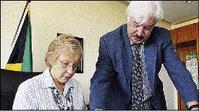
Dr Carolyn Gomes, executive director of Jamaicans For Justice, and Jurgen Engel, ambassador of the Federal Republic of Germany, sign the 'Access to Information and Human Rights Social Justice' project. The project is intended to encourage Jamaican citizens to participate in government decision making by improving public access to information related to public-sector operations. - File
The civic action/human-rights lobby group is defending its position in the face of criticisms about its role in society, and specifically in response to an editorial published in The Observer newspaper of July 30, 2008. An edited version of JFJ's response is published below.
Jamaicans For Justice questions the statement that there has been an "emergence of a preponderance of human-rights groups".
Preponderance in what - in numbers, weight, power, influence? Preponderance compared to what? We would suggest that the weight, influence, power and numbers of state agents (and other powerful private interest groups) far outstrip that of all human-rights groups locally combined.
In the listing of human-rights groups they forgot to list the largest and oldest group of human-rights defenders in the country: the Jamaica Constabulary Force (JCF). We presume this omission was not out of ignorance of its role. The JCF has as it primary responsibility the upholding of the laws, the protection of the citizens, the detection and investigation of crimes and the bringing of perpetrators to the courts. These functions largely involve the protection of human rights. We would add that one would expect that these agents of the State who are charged with the defence of rights and the rule of law would need to be held to a higher standard than that of the so-called 'criminals'.
Common target
They say that the groups they do list, "JFJ, IJCHR and FAST appear to have a common target". What an unfortunate choice of words and what an unfortunate display of ignorance. The three groups listed have as a common aim the 'defence of human rights'.
They defend these rights in many different ways and with many different projects. What they do, together with most non-govern-mental organisations - defending rights internationally, is that they work in the area where the imbalance of power is most marked and the protection of rights most vulnerable, the place where the power of the State is used against the individual.
The simple explanation we use is: When the gunman is breaking down your door, you call the state agents (119 in Jamaica) for protection. When it is the state agents who are breaking down your door who can you call?
The editorial stated, "It cannot be that breaches of human rights are only contained in abuses by the police and/or soldiers." We would absolutely agree and question the implied ignorance of all the other work carried out by human-rights groups, a lot of it previously highlighted in the media. For the readers, we would simply list JFJ's work on Access to Information; abuse in the children's homes; defence of the right of the people to have a say in the character and composition of their final court of appeal (our work on the CCJ); human-rights education in schools, and with the police; social and economic justice with communities; and, our anti-corruption education projects, to name a few. To our certain knowledge, the IJCHR (the oldest non-governmental human-rights group in the Caribbean) has extensive programmes on human rights.
Loud cries
The editorial's comment that there is an "inordinate insistence on making loud cries when the security forces go wrong but never nearly enough when criminals and other groups go wrong" again betrays a profound lack of understanding of the role and mandate of non-governmental human-rights groups.
We would suggest that there is absolutely nothing wrong with our loudly pointing out the egregious abuse of power by state agents who are given power and resources by the citizens for lawful activity. We will continue to do so as long as those abuses continue.
To suggest that our work has created "the unfortunate perception that our human-rights groups are more interested in the welfare of alleged criminals than in their alleged victims" does their editorial board a grave disservice. It also does a grave disservice to the victims whose stories we have highlighted over the years, including Janice Allen, Jason Smith, Amanie Wedderburn, Renée Lyons, Michael Gayle, Angela Fennel Reid, Damion Roache, Hapete Henry and many others.
JFJ takes grave exception to the statement that "because their funding is attached to their stated mandate, human-rights groups feel constrained not to stray from their articles of association or their memorandum of understanding". We stay true to our articles of association and memorandum of understanding out of a commitment to principle and an understanding of our mandate and find the suggestion that it is money that drives us, deeply offensive and completely unfounded.