Paul Messam, Gleaner Writer 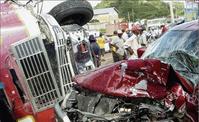
This trailer truck (left) was transporting sand, got out of control and overturned along Kings Land main road in Manchester. Many such accidents are caused by skidding on wet roadways. - Norman Grindley/Deputy Chief Photographer
THE CLIMBING number of road accidents and fatalities has prompted the Road Safety Unit in the Ministry of Transport to embark on a serious education programme to raise public awareness of the dangers of skidding, which is identified as a major factor in road accidents.
Kanute Hare, road safety director in the Ministry of Transport, tells Automotives that the programme is geared towards raising public awareness of how to anticipate and deal with the impact of skidding.
The unit has developed what it terms 'anti-skid resistant measures' to help motorists, based on its assessment and analysis of traffic crashes across the island for the period 200 to 2007. It highlighted the most frequent locations where anti-skid intelligence is needed to ensure safety.
More research needed
According to Hare, while St James, St Mary and St Andrew were identified as parishes with the highest concentration of skid crashes, additional research is required in order to ascertain the level of engineering of the roadways. The report, however, states that for the period reviewed, there were one thousand and sixty two traffic crashes due to skidding. Twenty-nine per cent were head-on, while 42 per cent were single-vehicle crashes and 4 per cent were rear-end crashes.
A further breakdown of the data reveals that 34 per cent of these collision occurred during rainy weather while 56 per cent occurred during fine weather. Twenty-six per cent of these collision occurred when it was foggy, while 55 per cent occurred when the road surface was wet and asphalted. Of note is the fact that a high percentage of these crashes took place when the road surface was wet and asphalted, or when it was rainy.
Trouble spots
The traffic data also show that skid crashes occurred most frequently along the Devon Pen, Faiths Pen and Llandovery road in St Ann; Prospect main road, Portland; Windward Road and Sir Florizel Glasspole Boulevard in Kingston. Most of these crashes occurred in daylight on the straight roadways.
Speeding on wet surface was identified as the main cause for skidding. "This is is dangerous and can lead to hydroplaning," advises Hare. His department is in the process of putting out a pamphlet on speeding, which will cover such areas as visibility (tyres churning gusts of water on to the windscreen can impair vision and douse other roads users, also impairing their vision), traction and vehicle control.


















