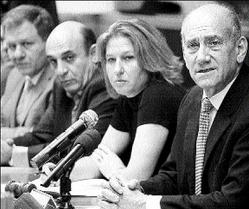
From left: Housing and Construction Minister Meir Shitrit, Transportation Minister Shaul Mofaz, Foreign Minister Tzipi Livni and Israeli Prime Minister Ehud Olmert attend the weekly Cabinet meeting in Jerusalem, on Sunday, July 20. Olmert announced yesterday that he was stepping down as prime minister in September. Livni and Mofaz are widely regarded as among the favourites to succeed Olmert. - AP
JERUSALEM (AP):
Israeli Prime Minister Ehud Olmert announced yesterday he will resign in September, throwing his country into political turmoil in a move that could stall delicate peace efforts with both the Palestinians and Syria.
Olmert said he would not run in his party's primary election, set for September 17, and would step down afterward "in order to allow the chairman to be elected and form a different government quickly and efficiently''.
Olmert's popularity dropped below 20 per cent at one point after his bloody but inconclusive war in Lebanon in 2006, and a string of corruption allegations and police interrogations have battered him in recent months. Political analysts here have predicted his resignation for weeks.
Appeared angry
Olmert's brief address, given at his official Jerusalem residence, included harsh criticism of police investigations of corruption allegations against him. He said he was choosing the public good over his personal justice. He has consistently denied wrongdoing but pledged to resign if indicted.
Appearing angry and reading from a prepared text, Olmert said, ''I was forced to defend myself against relentless attacks from self-appointed 'fighters for justice' who sought to depose me from my position, when the ends sanctified all the means.''
Olmert did not answer questions from reporters gathered in the courtyard of his residence on a warm summer night.
Nomination process
His decision not to run in the Kadima Party primary sets in motion a process to choose a new prime minister. Main candidates in his party are Foreign Minister Tzipi Livni and Transport Minister Shaul Mofaz, a former defence minister and military chief of staff.
Polls show Livni with an advantage in the primary. If she were to replace Olmert, she would become the second female prime minister in Israeli history, after Golda Meir.
If Olmert's successor as party leader can form a coalition, Israel could have a new government in October. If not, an election campaign could take several months. Olmert would remain in office until a new premier is chosen, heading a caretaker government after he submits his resignation to President Shimon Peres.


















