
Kenneth Gardner - FITNESS CLUB
More benefits are derived from regular, moderate exercise than from a few irregular, intensive sessions. There are numerous reasons for the difficulties we experience in exercising regularly. For example, consider whether the exercise prescriptions meet our individual needs; does the level of exercise match our individual needs and are the sessions novel and exciting enough to maintain interest and participation?
The 'arrangement principle' should be an integral factor in the development of any exercise prescription. This can be appreciated more easily when we see its application in weight training which has now become a regular fixture in most exercise prescriptions.
A weight training routine should be arranged so that the larger muscles and muscle groups are exercised before the smaller ones because the smaller muscle groups become tired and fatigued more quickly and easily. However, many of us violate this concept and then become tired long before we have had the meaningful challenges to provide the real benefits that we badly need. Similarly, exercise sessions should be arranged so that we are not doing two successive exercises that involve the same muscle groups.
The following is an indication of the most desirable order to exercise the muscle groups under normal conditions in order to attain the best results in a weight training routine. This order is as suggested by The American College of Sports Medicine:
1. The upper legs and hips are provided with big strong muscles and this is the ideal place to start.
2. The chest and upper arms are next in line especially because these muscles are so involved in our activities of daily living.
3. The muscles on our back and the posterior section of our legs are next in line.
4. Our lower legs and ankles should be exercised next followed by our shoulders and the posterior aspect of our upper arms.
5. At this stage the abdominal muscles will benefit more effectively from a weight- training experience.
6. Lastly, the muscles on the anterior portion of the upper arm.
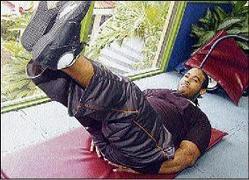
Focus on the larger muscles, such as the legs, before the smaller ones when exercising. Efficient leg raises demonstrated by Damion Christian, fitness trainer at Gymkhana, Hilton Kingston hotel. - Rudolph Brown/Chief Photographer
Here are a few exercises you can start with:
Leg squats
Place a bar with moderately heavy weights on your shoulder, behind your head.
Squat down so that your legs are at a 90 degree angle then return to the starting position.
Do a number of repetitions then rest.
Do at least three sets.
Bench press
Lie down on the bench with your shoulders flat on the bench.
With the use of a bar with relatively heavy weight, space your hands evenly on the bar.
Flex your elbow as you lower the bar to your chest and then forcefully push the bar back to the starting position.
Inhale deeply as you lower the bar and exhale forcefully as you push the bar upwards.
Rear cable kicks
Attach an ankle cuff to your left leg.
Rotate the cuff so that it is on your shin.
Attach the cable on the cuff to the pulley.
Stand back from the pulley.
Use the muscles on your seat and lower back to slowly move your leg to the rear and upwards as high as is comfortable.
Hold that position for a few seconds then lower your leg slowly to the starting position.
Do a number of repetitions then repeat the routine with the next leg.
Dr Kenneth Gardner is an exercise physiologist at Holiday Hills Research Center; email: yourhealth@gleanerjm.com.