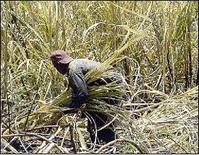
A sugar-cane cutter employed to the St Thomas Sugar Company in Duckenfield, St Thomas, harvests cane for milling. - photo by Gareth Manning GOVERNMENT, WITH support from the European Union, is to pay out a sweet $2.7 billion redundancy package for the island's sugar-cane workers by September 30, when the divestment of state assets in the Sugar Company of Jamaica to Brazilian buyers Infinity Bio-Energy is complete.
With the expectation that they will not be rehired, several workers tell The Sunday Gleaner they are looking forward to their redundancy packages. Others are willing to return to work if the new company chooses to re-employ them, while many are anxiously awaiting redundancy.
It is a change in the life of the affected workers, many of whom have spent a lifetime in the industry.
"Me see it (redundancy exercise) as a start in life for most a wi and it can mek wi into a man," says Glenfore Suckoo from Lionel Town in Clarendon. He has been working at the Monymusk sugar factory since 1986 as an auto mechanic.
compensation funds
He plans to use his compensation funds to realise his dream of opening a laundromat in his small town, and believes divestment will also be good for the Mony-musk factory, which is operating inefficiently.
"The cane yard badly in need of repair. All the column that the factory is on, vibration will collapse it anytime," he says.
Dave Allen, a tractor driver who has been with the company for 15 years, agrees that the divestment will increase the factory's efficiency. He believes the estate can produce several thousand tonnes of sugar cane per year; however, due to poor care of the crop, the company is often left without sufficient sugar cane for milling. Some parcels of cane lands are frequently overgrown by grass, he claims, starving the crop of nutrients.
"Wi want the redundancy, man. Mi want the money fi go run taxi pon the road," states the father of six.
Sugar production is his only source of income which guarantees him $700 per day. However, like many others, he is only employed for half of the year, during harvesting.
Forty-five-year-old Jean Pitter-man, also facing redundancy, is worried about her housing arrangements. She, her husband and teenage daughter have been living for seven years in the sugar barracks just outside the gates of the St Thomas Sugar Company factory in Duckenfield, St Thomas.
workers to pay bills
"When the new company takes over, we will have to pay water rate and light bill and we have to pay rent," she says. Currently, the company offers the use of those amenities free to workers living on the estate.
Although she is quite happy for the redundancy payment, she is not so sure how the family will spend the money.
"You have to ask mi husband, him know more than mi bout it," she shares.
Forty-five-year-old cane cutter Calvin Reid says he will be investing his funds with the bank. He has been working at the factory for 20 years.
"Mi a bank the money and see if mi can get a little place fi buy and make up a little house on it," he says.
He, like many other cane cutters in St Thomas, is hopeful the new owners of the factory will rehire him.
- G.M.