
Wilberne Persaud - Financial Gleaner Columnist
TOURISM IS a major Caribbean economic driver with huge investments, foreign and domestic, existing and planned.
Both supporters and opponents of the current tourism industry model, surprisingly it will seem to some, have used the same basic statistics to argue variously, that the net benefit to the Caribbean is huge, very small or even negative.
These arguments have centred on the tourism dollar multiplier and the environment.
The multiplier, a number which econometricians generate, tells us by how much a tourist dollar must be multiplied to arrive at impact on the economy. Mind you, this says nothing about the private gain of tourism operators. But that private gain must be viewed against the backdrop of the infrastructure, environment, airlift capacity, cultural diversity, social capital, etc, that make the business possible.
Tourism is the sector of our economies everyone agrees is most dependent on the 'soft' elements of our social infrastructure.
All-inclusive hotel operations recognise at least one element of this reality. Their operations provide a perfectly workable solution that at one level is great, but at another, lamentable.
They insulate the visitor from the society. So, there is no chance of harassment, but, also none of getting to know the culture or other elements of the societies that render them unique.
Is there a solution?
So what, this is the real world in which we must live, you say? Can there be some workable com-promise, you ask? Should we find it, would we not have hit on a hugely profitable venture-cableway to the Blue Mountains? But let's get back to ground.
In Jamaica alone, hundreds of millions of dollars have been invested in tourism establishments. These funds have come from private enterprise in the form of investment dollars, entrepre-neurship, tremendous risk taking and foresight.
Caribbean people, through their governments, have invested significantly in hotel construction and financing, airports and as well tax benefits or holidays, import duty drawback or whatever they are called - these are investments by the people.
So, we come back to Air Jamaica. All the cumulative losses of the airline that have been absorbed by the budget are investments by the people of Jamaica. Mind you, they were never asked specifically if this investment should be made, but they did not seem to care because once they got aboard, they had a great feeling.
Power of experiences
They hear sweet reggae sounds, are attended to by pleasant Jamaicans, initially ladies, but now also men, and experience landings which routinely cause eruption of spontaneous applause. Truly, that little piece of Jamaica flies. We ought not to underestimate the power of these experiences.
Yet, at a time when there is no truly regional Caribbean airline, with the worldwide airline industry facing hitherto unimaginable developments, our decision seems to be: scrap the national airline. From The New York Times, we learn of the United States that: "the country's two biggest airlines, American and United, announced plans to lop cities like Fort Lauderdale out of their networks", that there are cuts to come "on international routes to cities like London and Buenos Aires, and even to popular vacation destinations in the United States like Las Vegas, Honolulu and Orlando".
Awkward decision
United States (US) airlines are likely to record over US$13 billion in losses in 2009, an outcome worse than the post 9/11 situation.
Surely, this is not the time to package any airline for sale. Worse, to get rid of a national airline in a situation of complete dependence for airlift and our tourism sector on this entity seems to be an awkward decision.
Of course, the purchaser will have to sign on to guarantees: airlift will be available in disaster situations as in post-hurricane periods; the mail will be given priority; there shall be a minimum airlift of 'x' number of passengers from North America and 'y' number of passengers from Europe, etc. Whatever.
Contracts are enforceable in the courts but should they be dishonoured, the offended party must be able to withstand the negative impact while the courts take five years to sort it out. Not a pretty scenario.
The need is valid
The multilaterals will argue that subsidy is unfeasible and disallowed, but we should note that the US congress would not sit idly by and allow sovereign Chinese or Arab funds to purchase US airlines; much as they would not allow them to own and operate port facilities, or cease creating farm bills with huge, sometimes almost unknown subsidy impacts.
In other words, regardless of all advice to the contrary, there is need to review Air Jamaica and, for that matter, the possibility of a regional air carrier from a perspective that relies not merely on the accountant's private calculation of profit, but on the overall impact on Jamaica and the Caribbean.
After all, when Air Jamaica flew to Los Angeles and Frankfurt, those decisions were never for its bottom-line health.
Why not, indeed, consider a regional response to this problem? Is such a thought utterly sentimental? Might there really be a business model that can generate profits while providing the Caribbean with the passenger airlift it needs for its tourism sector to continue in existence, thrive and grow? Could abandoning Air Jamaica be a truly unavoidable, yet absolutely unaffordable loss?

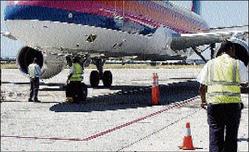
An Air Jamaica plane sits on the tarmac at the Norman Manley International Airport, Kingston. - File
wilbe65@yahoo.com