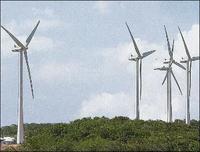
A section of Wigton's 683-acre wind park, located in Manchester, which provides renewable enery. - FileIN SPITE of what looks like a promising exploration for oil and gas, energy consultant Dr Raymond Wright is urging the country to maximise use of its indigenous energy resources if it intends to halve its dependence on oil by 2017.
"We need to develop to the maximum capacity all our domestic and indigenous resources. Unless and until we find our own gas and oil and gas resources, (our energy resources) will have to rely on the renewables," urges Wright.
Jamaica's renewables include hydropower, wind energy and solar energy - all of which the island already has plenty.
Minister of Energy Clive Mullings, in Parliament last week, announced a raft of initiatives to improve the input of renewables into Jamaica's energy matrix. He announced that renewable sources should be contributing approximately 15 per cent of total energy consumption by 2015 and 20 per cent by 2020.
The initiatives to be implemented include the expansion of the capacity of Wigton Windfarm in Manchester by 18 megawatts. The windfarm is already producing 20.7 megawatts of electricity. The Government is seeking a private power company to partner in the expansion venture.
more potential
Wright believes Jamaica's wind power, which represents the largest resource of renewable energy, has more potential. He points to at least 80 to 100 megawatts of energy of additional wind on shore, most of it in Manchester.
"In the great valleys south of Wigton, there is probably 30-40 megawatts, and then there are other sites in St Catherine and St Thomas," he says.
Wright also thinks the island's hydropower supply can be doubled. The country already has 24 megawatts of hydropower installed and there is potential to increase it to 48 megawatts.
He says while Jamaica will have to continue depending on oil as a source of fuel for transportation, the country must seek to diversify its energy resources for both transportation and electricity.
"Oil, in my view, has become too precious a commodity to be used for electricity generation and anywhere it is being used for electricity generation, there should be plans to phase it out," Wright argues.
Jamaica's oil bill was over US$2 billion last year, doubling its oil expenditure for the previous year. The rise in the oil bill has been largely due to the rapid growth of oil price, which peaked at US$145 per barrel last week. Analysts are predicting it will reach US$200 per barrel by year end.
A combined 44 per cent of Jamaica's imported oil is consumed by the transportation and electricity sectors.
Minister Mullings also announced that plans are afoot to reduce the nation's dependence on oil as a transportation fuel by adding 10 per cent ethanol to gasolene. The new fuel will be called E10 and will be available islandwide by April next year.
Coal is also being considered as an alternative energy source for electricity generation. At present, it provides 39 per cent of electricity generation globally and there is a good supply. There are extensive coal reserves that will last well up to 100 years in North America, Brazil and Colombia.
gareth.manning@gleanerjm.com


















