LIKE A hot-air balloon untethered, consumers are seeing increasing amounts - ranging between 100 and 250 per cent - on their light bills. Local energy experts say Jamaica Public Service's (JPS) operational losses are unreasonably high and its systems inefficient.
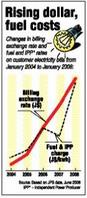
But, the Office of Utilities Regulation (OUR) has come out in defence of the energy supplier. David Geddes, the OUR's director of consumer and public affairs, states that while their energy consumption might not have increased, consumers are now seeing bills, which are two and three times the amount paid for light in June 2008, because of the ballooning cost of petroleum.
adjusted only for inflation
The energy rate which was set by the OUR in 2004 and adjusted only for inflation has changed merely by a few cents on the dollar since that time, Geddes claims. Last week, the OUR announced an under two per cent adjustment to the non-fuel electricity rates. Geddes attributes the major source of price movements to oil price movements which have quadrupled since mid-2007.
The fuel and IPP (independent power providers) component of light bills, Geddes notes, now amounts to approximately 80 per cent of general charges as opposed to only 40 per cent in mid-2008.
He also says that it was unlikely that JPS was passing on losses, due to theft and other causes, to consumers, as the grea-ter portion of losses caused by stolen light and line trans-mission losses are borne by the company itself, not by consumers.
Only 5.8 per cent of this loss, Geddes points out, is represented in the energy rate, which currently averages 20 per cent of the light bill which consumers receive.
But, local energy expert Zia Mian, a former adviser in the Office of the Prime Minister, is one of several voices stating that with 40 per cent of its output network being over 40 years old, the JPS heat rates are high and power-generation efficiency is low. Consumers, Mian believes, could be getting a better deal.
In 2007, Mian notes, JPS's system efficiency was about 25 per cent while the IPP's efficiency was about 41 per cent. With high heat rates, JPS uses expensive diesel oil because 34 per cent of its plants are diesel based. Consequently, the fuel charge in the electricity bill is high.
In the long term, action taken to reduce inefficiencies could impact costs to the company and in turn, consumers, states Mian.
"With improved heat rate and modernisation of old plants, JPS can considerably lower its heat rates and improve the generation system to use less expensive fuel, which would, in turn, have impact both on fuel and non-fuel components of the bill.
"In the medium term, JPS needs to switch away from expensive petroleum-based fuels. It needs to bring both the technical and non-technical losses to more acceptable levels. In the industrialised economies, the losses average around 7.5 per cent. In a country like Jamaica, where theft is prevalent, the acceptable level could be around 12-13 per cent," Mian adds.
avia.ustanny@gleanerjm.com
Regulator defends JPS
JPS reported that in 2007, the company was affected by significant events that negatively affected financial performance and its energy loss-reduction campaign. In 2007, energy sales increased only marginally (0.3 per cent ) over 2006. Overall, the company earned $6.4 billion more than it did in 2007 or 20 per cent more. While gross profit was $16.3 billion, the company posed a net loss after tax of $515 million for 2007.
"Increases in world oil prices and the islandwide blackout of 2007 forced the organisation," the company reported, "to critically analyse and make an extra effort to improve internal process."
The restoration effort following Hurricane Dean also resulted in unplanned expenditure for the company as well as a significant fall in energy sales during the period. The recovery efforts costs the company approximately $688 million. Loss of revenue was $410 million and loss of capital, due to the hurricane, was $135 million. The overall impact was $1.234 billion.