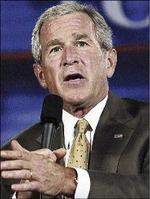
US President George Bush.WASHINGTON, D.C. (AP):
The problems do not get any easier as President George W. Bush attends his final summit with leaders of industrialised democracies.
Disputes over global warming, worries about soaring oil prices and uncertainty about Iran and North Korea's nuclear ambitions pose daunting challenges for Bush when he sits down with presidents and prime ministers tomorrow.
There are fewer than 200 days left in his term, and Bush's dwindling presidency is a major factor hanging over the meetings involving leaders from Japan, Germany, Britain, France, Italy and Canada at a Group of Eight summit in Toyako, on the northern Japanese island of Hokkaido.
There is a mix of high challenges and low expectations for the summit. Atop the agenda is reaching a deal that would set targets for reducing the pollution that causes global warming. But few expect major headway or concessions from Bush. He insists on holding China and India, fast-growing economies and among the world's biggest polluters, to the same emission-reduction standards as older, developed economies.
reduction in greenhouse gases
Japan's prime Minister, Yasuo Fukuda, would like to emerge with an agreement on 50 per cent overall reductions in greenhouse gases by 2050.
Some European countries and developing nations favour establishing targets for cutting emissions by 2020. Scientists say those targets are needed to avoid the worst effects of global warming.
Bush planned a pre-summit meeting and news conference today with Fukuda. On the sidelines of the G-8 meeting, Bush also scheduled separate meetings over the next few days with the leaders of Germany, China, South Korea, Russia and India.
Michael A. Levy, director of energy security and climate change at the Council on Foreign Relations, a New York-based think tank, said he did not expect breakthroughs on global warming, in part because other G-8 members realise that Bush's days in office were dwindling.
The Japanese, who are driving the agenda and favour strong emission-reduction targets, "acutely understand there is going to be a different American approach to climate change in a year," Levy said.
Both presidential candidates, Democrat Barack Obama and Republican John McCain, have argued for stronger standards for reducing greenhouse gas emissions than those advocated by Bush.
"We'll have a new US president in office. The expectation is that either McCain or Obama would be a little bit more forward-leaning and we could make some more headway," said Julianne Smith, director of the Europe programme at the Center for Strategic and International Studies.
climate-change pact
The United Nations began negotiations late last year on a climate-change pact to take over when the first phase of the Kyoto Protocol - which the United States has not ratified - expires at the end of 2012. Negotiators face a deadline of December 2009, when some 190 nations will meet in Denmark.
Bush said he supports efforts to agree on setting short-term and long-term goals. But he also said countries such as China and India - not subject to the same cuts that apply to more developed industrial economies - need to be included. "It's tough to get consensus," Bush said.
Bush has urged a halt in the growth of carbon dioxide and other greenhouse gases by 2025, but has not offered a strategy for pollution reductions or backed mandatory emission cuts. He has supported an increase in auto fuel economy, a requirement for a huge increase in use of ethanol and other biofuels, and for developing clean energy technologies.
priorities
Bush himself says a priority of this year's summit is not advancing new initiatives but making good on ones from previous summits, especially promises for health aid for countries in Africa and other underdeveloped nations.
"We need to show the world that the G-8 can be accountable for its promises and deliver results," Bush said ahead of the summit. "America is on track to meet our commitments. And in Japan, I'll urge other leaders to fulfil their commitments, as well."
More than 1,000 people marched in northern Japan on Saturday to protest the summit. Police arrested four protesters after a brief scuffle.
Demonstrators at a park in central Sapporo demanded that the summit nations take urgent measures to stop global warming, grant indigenous people greater rights, combat world poverty and battle discrimination.
Bush's trip comes amid fresh questions on the makeup of the Group of Eight and its relevance to today's global economy. When the gathering was first set up in the 1970s, it consisted of five nations that were the world's undisputed economic powerhouses, all democracies: the US, Britain, Japan, France and Germany.


















