
Robert Buddan POLITICS OF OUR TIME Robert Mugabe of Zimbabwe is faced with sanctions from the west, mediation by Southern Africa and a call for a government of national unity from the African Union. The African Union opposes western sanctions being organised by the French leadership of the European Union (EU) and the American leadership of the UN Security Council with the British in tow.
How did Mugabe, hero of the African liberation of white-ruled former Rhodesia, get himself in this situation? Mugabe was leader of the liberation movement, Zimbabwe African National Union (ZANU), which had fought for independence against the apartheid-like policies of white-ruled Rhodesia, a country that had relied on the support of apartheid South Africa. In fact, Zimbabwe's 17-year liberation war paralleled that of South Africa's African National Congress (ANC) and both leaderships (Mugabe and Thabo Mbeki) remain close today.
The former Rhodesia became independent as Zimbabwe on April 18, 1980. Mugabe's forces had succeeded 10 years before Nelson Mandela's did. However, although independence had been won, decolonisation was far from over.
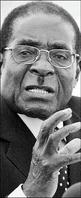
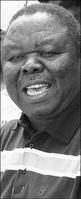
Mugabe and Tsvangirai
COLONISATION AND LAND RIGHTS
Colonisation began when Cecil Rhodes, with the backing of the British, took over land that is now mostly Zimbabwe. The Shona and Ndebele people fought their first liberation war in 1896/97 to get their land back but white power only grew. White agriculture flourished and the Shona and Ndebele were shunted off into 'African reserves', the dust bowl of Zimbabwe. Even when the war for liberation won independence it was a highly compromised independence.
Rhodesia's whites had made up less than five per cent of the population but held 95 per cent of the votes and 70 per cent of the Africans' land. An agreement for independence reserved as many as one-third of the parliamentary seats for these whites, 20 Assembly seats and 10 seats in the Senate, and whites remained in control of the police, army, air force judiciary and civil service. Mugabe's liberation government abolished the reserved assembly seats at the first chance in 1987 and the Senate seats in 1990. Political power had finally been won but the real problem of economic power - control of land - had not been.
The compromise constitution only gave Mugabe the justifiable right to change it and in doing so gave himself more power, probably too much power, in the process. The Shona-Ndebele Patriotic Front (PF) led by Mugabe's ZANU (ZANU-PF) proceeded to consolidate its presidential, parliamentary, military and administrative power.
Up to 1994, Mugabe, was still in the Queen's good books. Her government awarded him an honorary knighthood, though he never used the title 'Sir', but rather 'Comrade'. Elizabeth and her ministers have now withdrawn this archaic title.
ZANU-PF believes the knighthood was a bribe to encourage Mugabe to protect the white farmers who controlled Zimbabwe's best land from Mugabe's policy of '100 per cent black empowerment'. The liberation struggle had promised to give back the Shona and Ndebele their land but the land resettlement had not gone well because of white resistance and lack of sufficient money. Besides, the ZANU-PF government says that the British had reneged on their promise under the Lancaster House Agreement to support land reform.
RISE OF MORGAN TSVANGIRAI
About 1995, Morgan Tsvangirai emerged with the militant Zimbabwe Congress of Trade Unions to organise a newer generation of younger academics, economists and lawyers for a new constitution, a new politics and a better land settlement policy appealing to the urban poor and the landless peasants alike. Mugabe comes from the Shona tribe and Tsvangirai from the Ndebele, both of which actually have a tense history despite their strategic political alliance. Tsvangirai had been a senior member of Mugabe's ZANU-PF,
By 1999, the failure of Mugabe's land settlement had caused thousands of veterans of the liberation army and frustrated youth to invade white farmer's lands and also occupy idle land owned by government and rich urban land speculators. Mugabe's government was thought to encourage this invasion to defuse anger over failure of the liberation war's land promise. Mugabe tried to fend off the rising opposition under Tsvangirai by proposing, among other things, new powers for himself under a new constitution to expropriate land but it was defeated in a referendum in 2000. Tsvangirai's forces arranged their own constitutional consultations with land again being the major issue.
To Mugabe's credit, the defeat of the referendum showed that there was still enough democracy in Zimbabwe. In fact, from 2000 onwards, Morgan Tsvangirai's Movement for Democratic Change (MDC) began making strong showings in parliamentary and presidential elections. By March 2008, the MDC had won a majority of parliamentary seats and Tsvangirai had won 48 per cent of the presidential vote to Mugabe's 43 per cent.
However, under Zimbabwe's new election system, a candidate has to receive 50 per cent or more of the votes and if he does not, a second-round election is held between the two best first-round candidates. Hence, Mugabe and Tsvangirai had to contest again on June 27. Tsvangirai pulled out saying violence and intimidation would make the elections unfair. By doing so, he also did.
Even before the vote, western countries (G-8) said they would not recognise Mugabe's government. Countries like Nigeria had suggested that the election be postponed until conditions were better. Mugabe said he was willing to talk with the opposition, but after the elections. In truth, the G-8 should have waited for the African Union to take the lead but in its usual arrogance, declared its position ahead of the continent.
It was not even willing to contemplate a negotiated settlement. It had undercut the role of the South African President, Mbeki, as official mediator. One MP in the European Parliament was right to say that a process led by the African Union aimed at mediation, as was successfully achieved in the Kenyan election dispute of just a few months ago, should have been tried. ZANU-PF complains, "It was a travesty of natural justice for those who had colonised Zimbabwe and denied its people basic human rights for centuries to suddenly change into champions of democracy."
ISSUES FOR NATIONAL UNITY
Robert Mugabe remained popular in Africa as a liberator right up to the period after the March elections. Public opinion in other African countries became more critical because of accusations of violence against the opposition. Mugabe, at 84 and in power for 28 years, should really have stepped aside for younger leaders of ZANU-PF long before this. Other African heroes like Julius Nyrerere (Tanzania) and Nelson Mandela did so even without pressure.
The west needs to think more constructively and to remember that the lives of African people fighting for their land for over 100 years is what is really at stake. Africa's mediation efforts and a government of national unity should (1) demand an end to sanctions and the threat of sanctions; (2) agree to major land reform for Shona, Ndebele and all Zimbabwean people; (3) support economic recovery, especially price stability and job creation; and (4) work for peace and democratic stability.
The MDC would have the comfort of a parliamentary majority to check and balance the power-sharing executive and that executive would have the confidence of the military chiefs who back Mugabe, and without whose support, Tsvangirai will not have the power he wants. Bob Marley's song Zimbabwe celebrated liberation but decolonisation is not yet over.
Robert Buddan lectures in the Department of Government, UWI, Mona. Email: Robert.Buddan@uwimona.edu.jm.


















