Barry Chevannes, Contributor 
Chevannes
A wave of scepticism from many quarters, including a Gleaner editorial, has greeted the announcement and signing of a peace treaty between warring factions in the August Town community. As long as the guns remain in the hands of the signatories and their gangs, so reason the sceptics, a peace agreement is a sham. The peace will not hold; we have been down this road before. For this very reason, the August Town Ministers Fraternal declined to join the list of signatories, though they welcomed the agreement.
There is cogency in this line of reasoning. The peace, which was brokered by the Peace Management Initiative (PMI), was not the first in that area, but the fifth over a period of 15 years - 1993, 1998, 2002, 2006 and now 2008. Obviously, the PMI, which was founded in 2002, figured only in the last three. In all the peace agreements prior to this latest one, demobilising the guns was never one of the terms, so that when the breakdowns occurred, the guns were easily brought into action and with deadly impact. Most of the scores of people killed over those 15 years were innocent, in the normal sense of that word, including a 12-month old baby girl whose murder in the arms of her mother so shocked the community that it contributed in no small measure to the partisans agreeing to give peace yet another chance. So, why should we invest any hope in this one, the fifth, when the guns are still out there?
criminal enterprise
In the first place, August Town violence is not the violence of organised crime, which is based on drug-trafficking, extortion or some other criminal enterprise. The PMI has never negotiated 'peace' between organised crime gangs. Only the police can deal with that. Rather, the violence in August Town is essentially 'tribal' - the People's National Party (PNP) tribe versus the Jamaica Labour Party tribe, but it has been complicated over the last 18 months by a splintering within the PNP tribe. It is more comparable, therefore, to Northern Ireland, once locked in a struggle between a Protestant tribe and a Catholic tribe, than to Colombia, where a state found itself rocked by organised criminal networks.
This being so, I offer one reason why we must welcome not only the restoration of calm to August Town but the opportunity it gives us to make peace a lasting and irreversible way of life. In none of the previous four treaties did we seize the opportunity.
Peace building is a process. It begins with the combatants facing each other, venting their partisan perspectives and in the end, agreeing to cease hostilities. This is only the beginning. If they fail to set up some mechanism to nip potential conflicts in the bud or to resolve them once they develop, regression is almost certain. But in addition, they must find ways of undertaking joint projects and activities.
build trust
These serve to build trust, but, in our local context, they also fill the void left by unemployment, idleness and generalised disorder. Critical also is the cultivation of a sense of personal development among the belligerents, in which their horizons are broadened through structured as well as unstructured and informal education and training, learning tours and visits, and engagement with the wider world from which they have been excluded or have excluded themselves. Most important, alongside these initiatives must be a stronger, more active role for civil society. The usual form is voluntary, democratically run citizens' associations and community councils that represent community interests and broker their development.
The Violence Prevention Alliance (VPA) from as far back as 2006, recognised peace building as a process, when, with input and guidance from the communities, it put together these ideas in a schema of five stages. The first is the most basic condition of a ceasefire and peace agreement, and the final is a level of development characterised by social justice, restored confidence in a deserving police force and a responsive justice system, respect for women, healthy and relatively happy children, and a free and open community. The inner-city residents who helped design this scheme suggested that each stage reached should merit a star. The more stars a community accumulates, the more deserving it is of external help to reach the next stage.
irreversible peace
A five-star community is, therefore, one in which peace is irreversible and the guns that have been silent for so long can be traded in or handed over.
Until the gun ceases to be the symbol of male aggression, honour and power that it now is for so many of our youths, and becomes instead a useless symbol, signifying nothing but the backwardness of troglodytes, until such time, it is unrealistic and pandering to sheer vanity to make it a non-negotiable demand that they be handed over from stage one.
No peace agreement will ever be reached in this way. The very reason we are in this pickle is precisely because over the past four decades, the State has been severely compromised by corrupt politicians and law-enforcement officers, and thus unable now to impose its will by force. We are at a dangerous moment in our development, requiring great wisdom and tact if we are to pull our country back from the abyss of total disorder and lack of control.
The PMI, by also signing the August Town agreement, does not condone the illegal possession of the guns that have criminally wiped out the lives of tens of citizens over the years. But as a member of the Alliance, it knows that this is a process, one that involves the risk of derailment, true, but one that may very well succeed. We will never know unless we try. Those who attack the PMI, the VPA and others for signing in on this process, do so unfairly unless they themselves can propose solutions that they have tried.
initiate dialogue with police
August Town is now almost at the one-star stage: It has a complete cessation of hostilities and a mechanism in the form of a peace council to resolve all conflicts peacefully. The youths will need to initiate dialogue with the police in order to improve relations. For the community to reach the two-star stage, there must be no brandishing of guns and no gun-salutes. This should not be difficult, for these are specific clauses of the agreement. Neither should there be any difficulty with the requirement that civil society should be allowed once again to assert itself, for there are an August Town Sports and Development Foundation, a Peace Builders Association and the beginnings of a community council.
The three-star stage, however, is going to prove more challenging. It requires greater integration and responsiveness of the State and local-government authorities in the life of the community, as well as the greater participation of men in the lives of their children and their spouses, in order to staunch the haemorrhage of our values system.
Here, the Mona campus of the University of the West Indies is prepared to play a role in mobilising its staff and students, bilateral funding sources and Government agencies like the Citizen Security and Justice Programme and the Social Development Commission, among others, to help.
no quick fix
The problem of criminal homicides did not descend on us overnight. There will be no quick fix, overnight solution. Even when the guns are silent, many still die from knife wounds and blunt instruments. The peace process involves helping our youth, especially the males, to acquire such self-esteem as would make them feel diminished and belittled merely to contemplate taking another's life, let alone taking it.
Barry Chevannes, professor of anthropology, is former dean of the Faculty of Social Sciences, University of the West Indies, Mona.

Jamaica Defence Force soldiers on patrol in a troubled community. - File
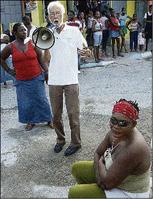
Horace Levy, senior member of the Peace Management Initiative (PMI), and Marie Bucknor, a resident of August Town, in this January 2007 file photo, urge community members to put an end to the violence that has affected the community for the previous 14 months, while a despondent resident listens.- file


















